


The residential debate took centre stage at the 10th anniversary of the Portugal Real Estate Summit, an event organized by Iberian Property.
The Housing Minister Miguel Pinto Luz, outlined the Government’s ambition to accelerate supply through Construir Portugal. Among the figures presented was a structural housing shortfall of more than 300,000 homes accumulated over more than a decade, alongside a longer-term objective of delivering 133,000 new homes. The question for the market was whether policy can now translate into actual development and investment.
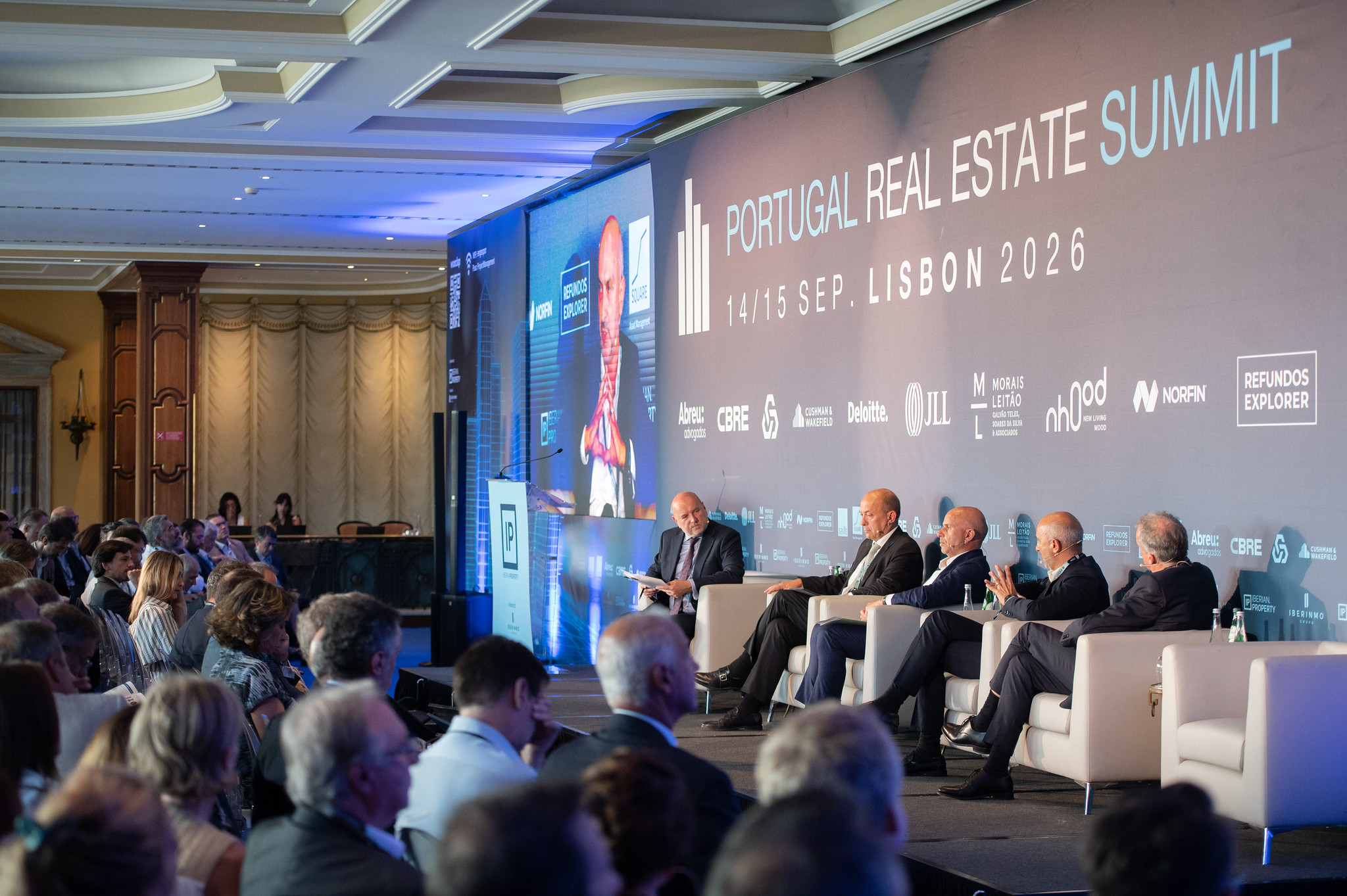
The answer was nuanced and brought by the following investors roundtable which gathered representatives from Sonae Sierra, Krest Investments, Caixa Geral de Depósitos, and Grupo SANJOSE.
“Portugal doesn't have a capital problem, doesn't have a demand problem; it has a product problem,” said Alexandre Fernandes, Executive Director Developments at Sonae Sierra. The opportunity is particularly clear in Build to Rent (BTR), where demographic demand is meeting a comparatively limited supply of professionally managed rental stock.
For Claude Kandyioti, CEO of Krest Investments, the Portuguese market has matured considerably since he first attended the Summit in 2016, when there were few benchmarks or reliable figures. Today, institutional participation and market data are much stronger, but he sees a disconnect between the increasingly sophisticated narrative around residential and the amount of activity actually taking place.
“There is so much opportunity still in the market and at the same time I don't really see it live,” he said. Portugal still needs consolidation and, above all, more product, with BTR notably underdeveloped compared with other European markets.
“Portugal doesn't have a capital problem, doesn't have a demand problem; it has a product problem”
Alexandre Fernandes sees strong structural fundamentals: smaller households, mobility, urbanisation and demographic demand, against a shortage of professionally managed rental stock.
But he also identifies a deeper structural obstacle. Portugal’s residential development model has historically been optimised for Build to Sell rather than BTR. The latter requires a longer-term, more integrated approach combining development, investment and operations, with a different risk profile.
Sonae Sierra is now testing precisely that model, with projects across both affordable and free-market BTR. The Executive Director of Developments at Sierra compares the strategy with the early development of the Portuguese shopping-centre market, when institutional capital was limited because the product and ecosystem had yet to be created. “Incentives are important,” he said, because they can reduce costs and risk, but “the fundamentals drive the sector”.
“Product still needs to be built”
For Joaquim Morgado, Board Member at Grupo SANJOSE, increasing supply also means changing how homes are built. Industrialisation, prefabrication and offsite production can reduce execution times, improve schedule predictability, address labour and skills constraints and reduce errors. But Morgado stressed that this is not a universal solution: it requires scale, repetition and integration into the project from the design stage.
SANJOSE’s experience with Spain’s Plan VIVE illustrates the potential. The first phase delivered around 3,400 homes in less than three years, supported by a factory producing around 90 prefabricated bathrooms a week. More than 11,000 have been produced to date, with slightly less than 6,000 used for affordable housing under Plan VIVE.
But industrialisation itself requires visibility. “We need a pipeline of projects” to justify investment in factories and offsite production, Morgado said.
“Are the Government's measures sufficient to increase supply?”
The panel broadly welcomed the direction of travel, but questioned execution. Claude Kandyioti described the Government as showing political will, while arguing that the problem goes beyond housing legislation. With 308 municipalities interpreting rules differently, investors still face uncertainty over timings and implementation.
For investors, the consequence is financial. “Time costs money,” particularly when financing costs are rising. Krest's CEO also pointed to the gap between licensing and actual construction: around 40,000–42,000 dwellings were licensed in 2025, but cement consumption fell in Q1 2026, suggesting that the impact of increased licensing has yet to feed through into physical construction. He called for greater simplicity in the system and a 6% VAT rate across construction.
Alexandre Fernandes described the Government’s package as “the most important and substantial package the sector has seen”, highlighting tax incentives, Simplex regulation and investment contracts capable of locking in the legal and tax framework for 25 years. But he also argued that more is needed: faster licensing, legal reform, a more functional eviction system and, crucially, public land at competitive prices.
“Otherwise we will not have the scale that we need for the sector.”
Spain shows the importance of predictability
From the construction perspective, Joaquim Morgado sees the main difference between Spain and Portugal not simply in capacity, but in the structure and predictability of the development process.
Plan VIVE provides a framework in which the State supplies land and establishes the rules, while private companies develop and finance the projects, with the approval, rental and exploitation framework clearly defined.
In Portugal, processes remain “smaller, more fragmented, more slow”, Morgado said. In some cases, SANJOSE can sign a contract and effectively lose almost a year before a project starts. For developers and lenders, that delay feeds directly into the financial model through financing costs, construction inflation and delayed income.
“What assumptions in a residential business plan make lenders uncomfortable today?”
For Francisco Ravara Cary, Deputy CEO of Caixa Geral de Depósitos (CGD), the lender’s perspective brings another layer of caution.
CGD has around a quarter of the Portuguese banking market for Build to Sell (BTS) financing and accounts for approximately 30% of new mortgage production. Around 80% of its development-financing demand remains indeed linked to BTS, underlining how far the institutional BTR market still has to develop.
The recent cycle has been positive — CGD currently has no defaults across its development portfolio — but Cary warned that this cannot simply be assumed to continue. The bank is increasingly requiring pre-sales, depending on location and segment, while construction costs have become one of the most difficult variables to underwrite.
Historically, CGD could finance up to 100% of hard costs where developers had fixed-price turnkey contracts. Contractors are now more reluctant to take that risk, meaning cost overruns can ultimately require additional equity or financing.
Cary also pointed to public land as a potential accelerator. Bringing land to market with clear, approved plans would reduce uncertainty for developers and lenders and allow projects to move more quickly. On BTR, CGD remains more comfortable where the municipality or Government acts as the eventual offtaker, reducing exposure to changes in leasing rules and tenant-related risks.
“Where do investors see the strongest opportunity now?”
Wrapping up the panel discussion, investors answers reflected different investment strategies.
Krest has been buying land and pursuing urban planning and regeneration. The process takes longer, he acknowledged, but “the upside can be massive”.
For Sonae Sierra, BTR is the central bet — but scale is essential. Fernandes called for faster mobilisation of public land at competitive prices, clear rules and well-structured public-private partnerships. “BTR is our bet but we need to accelerate,” he said.
The discussion ultimately returned to the same conclusion from several different angles. Portugal has demand, capital, lenders and construction capacity. What it lacks is enough predictable, scalable and economically viable product to connect those elements.
For the residential market, therefore, the next stage of the cycle will be less about announcing ambition and more about demonstrating delivery.