


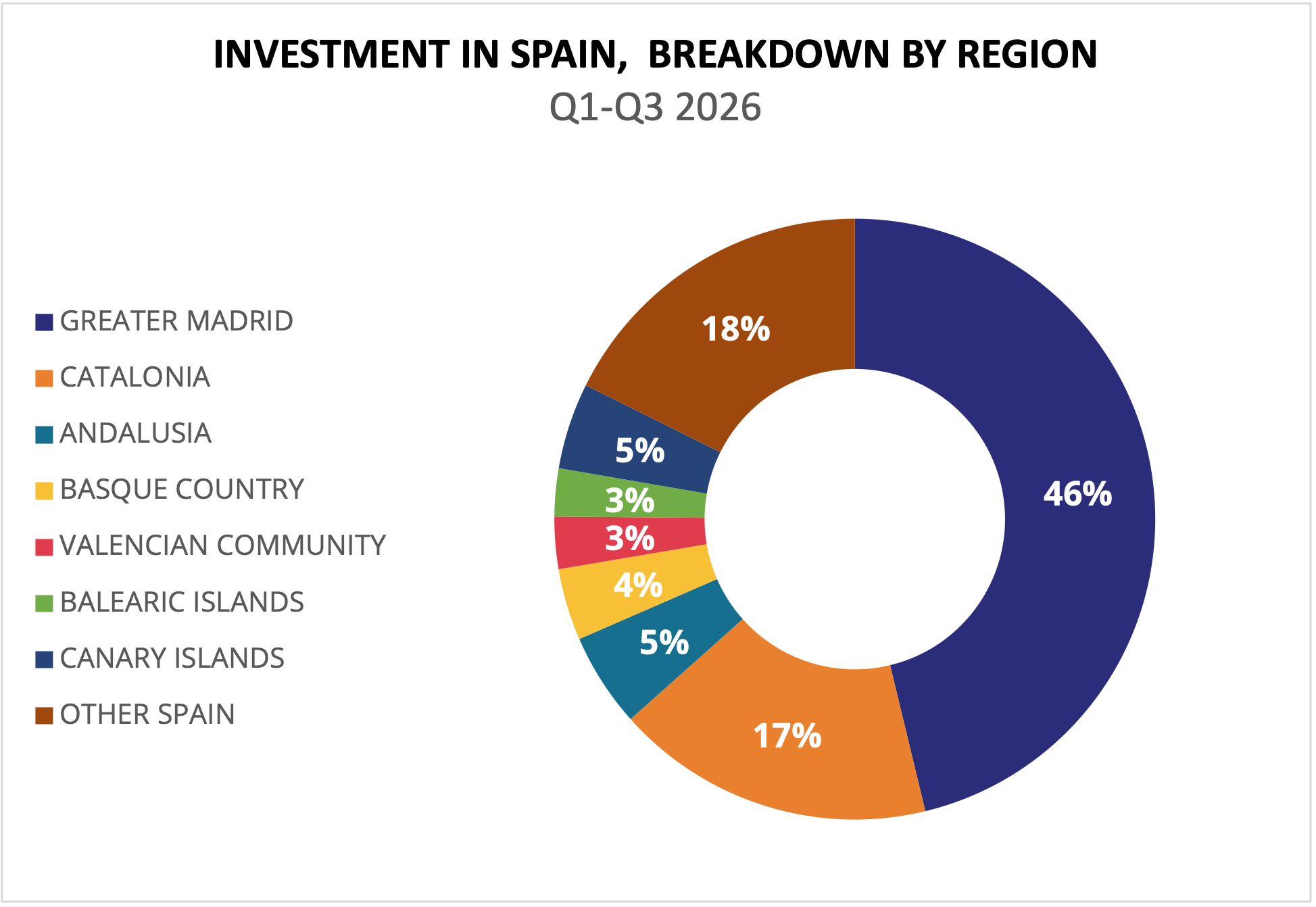
Greater Madrid attracted approximately €6.5 billion in commercial real estate investment between January and October 2026, according to Iberian Property preliminary estimates. This represents around 44% of Spain’s total quantified investment of €14.7 billion over the same period, consolidating the region’s position as the country’s leading destination for real estate capital.
Madrid’s performance over the first three quarters had already marked a substantial acceleration compared with 2025, an increase of approximately 76%. By comparison, the Spanish market grew by around 37%. Madrid’s investment volume has also exceeded by 35% its full-year 2025 total of €4.8 billion until now.
The pace of activity strengthened as the year progressed. Madrid recorded €1.85 billion in investment in the first quarter, followed by €2.2 billion in Q2 and €2.5 billion in Q3. The latest quarter was therefore the strongest of the year so far, suggesting that the market’s momentum continued beyond the large transactions recorded in the first half.
Residential and retail lead investment activity
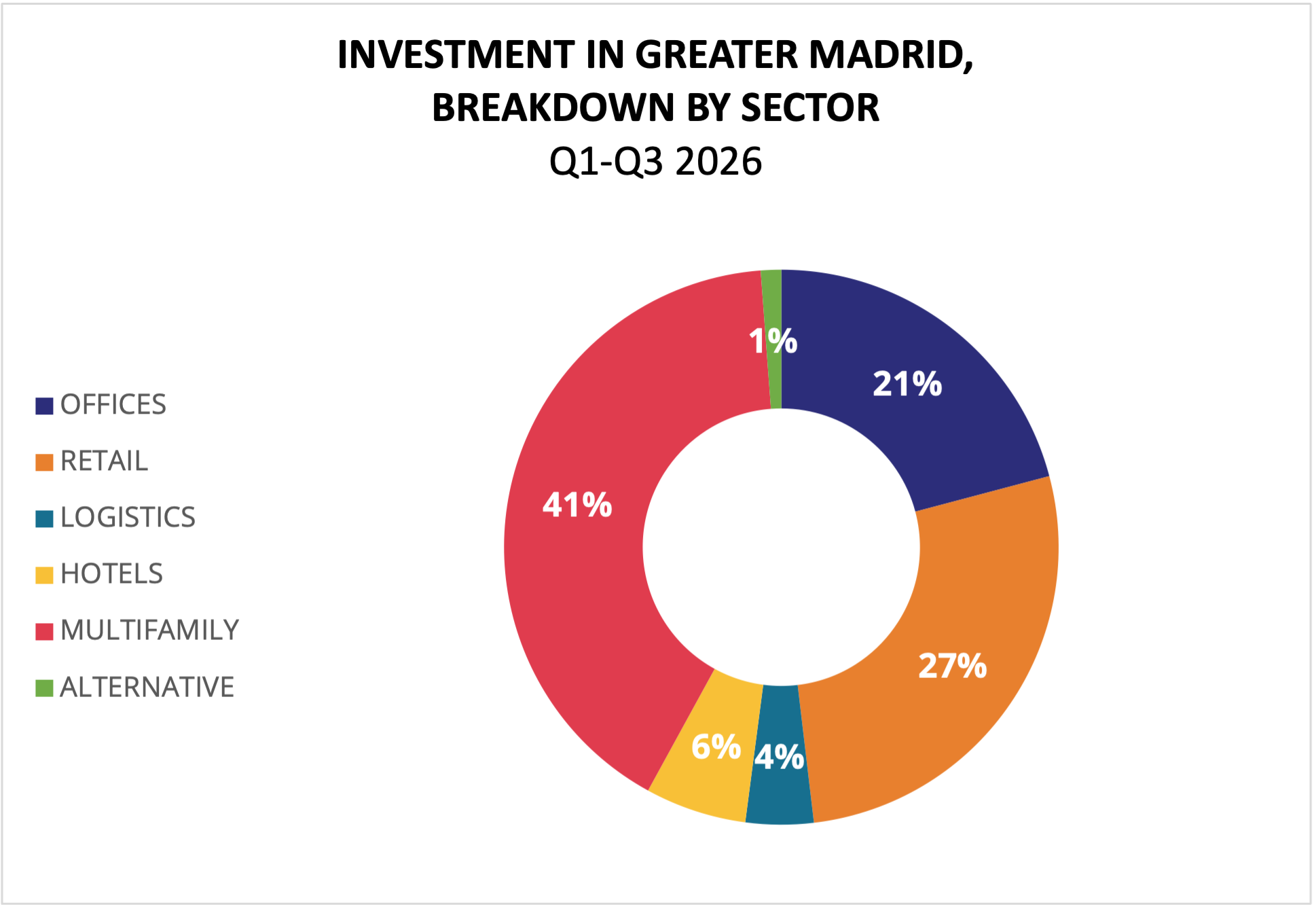
Multifamily was Madrid’s largest investment sector in the first nine months of 2026, accounting for 41% of the regional total, equivalent to €2.642 billion. Retail followed with €1.763 billion, or 27%, while offices attracted €1.351 billion, representing 21% of investment. Hotels accounted for €382 million, logistics for €256 million and alternative assets for €77 million.
Together, multifamily and retail represented approximately €4.4 billion, or 68% of Madrid’s investment volume. The figures highlight the importance of residential platforms and established retail destinations to the region’s current investment profile, while office transactions also made a substantial contribution.
The largest transaction recorded in Madrid during the first nine months was Brookfield’s acquisition of Fidere from Blackstone, valued at €1.05 billion in Iberian Property’s data. The residential transaction was followed by the sale of six shopping centres from a wider Spanish portfolio to Norges Bank Investment Management and Sonae Sierra, with an estimated €1 billion allocated to the six Madrid assets in Iberian Property’s figures.
Residential investment was further supported by the acquisition by the Healthcare of Ontario Pension Plan (HOOPP) of a portfolio of approximately 2,300 homes from Ares Management, valued at €690 million. Together, the Fidere and HOOPP transactions demonstrate the importance of large residential portfolios in shaping Madrid’s investment totals, alongside continued demand for income-producing retail assets.
The five largest deals in Iberian Property’s Q1–Q3 2026 data totalled approximately €3.33 billion, representing around 51% of the region’s recorded investment. In addition to Fidere, the six shopping centres and the HOOPP residential portfolio, the list included Castellana Properties’ €340 million acquisition of Islazul shopping centre from Henderson Park and Eurofund, and Rivoli Asset Management’s €250 million purchase of a 50% stake in Xanadú shopping centre from Nuveen Real Estate.
Investment extends across offices and alternative living
Beyond the largest residential and retail transactions, Madrid’s investment market recorded activity across a broad range of asset types.
Office transactions included Square AM’s acquisition of Omega Business Park for €104 million, Grupo Insur’s purchase of La Sierra Business Area for €81 million and IBA Capital Partners’ €85 million acquisition of the MBOne office building from Grosvenor. These deals underline continued investor interest in well-located office assets, although capital allocation remains selective.
Hospitality also featured prominently, with the €105 million sale of the Nômade Madrid hotel by Hotei Properties to GS Bacares Iberia. Meanwhile, alternative living formats continued to attract institutional capital. Meridia Capital acquired a 977-unit flex-living asset in Carabanchel from a Bain Capital, Momentum REIM and Episode vehicle for €130 million.
The build-to-rent segment recorded two significant transactions in September, when Starwood Capital acquired the Stay by Kronos Berrocales and Alcalá de Henares portfolios from Nuveen Real Estate for €130 million and €50 million respectively, covering a combined 1,154 homes. Student accommodation also featured, with Westwind Capital acquiring an 837-bed residence next to the Polytechnic University of Madrid from Merkel Capital for €90 million.
October development pipeline and major announcements
While investment volumes provide one measure of market performance, October also brought significant progress across Madrid’s development pipeline, particularly in residential construction and large-scale urban expansion.
One of the most substantial investment commitments came from Culmia and Cross Ocean, which are investing €400 million in a co-investment platform targeting 900 homes in the Madrid region. The initial portfolio comprises 163 homes in Valdecarros, in Madrid, and a further 737 in Retamar de la Huerta, in Alcorcón. The platform adds institutional capital to two major development areas and illustrates continued interest in large-scale residential projects around the capital.
Metrovacesa launched its second residential scheme in Los Cerros, comprising 115 homes and involving an investment of €27.6 million. The new project brings the number of homes planned by the developer across its first two phases in the area to 230. Meanwhile, GreenHabitat El Pinar, a cooperative managed by Grupo NiDra, is promoting a €30 million development in Brunete comprising 61 open-market homes with two to four bedrooms.
The scale of Madrid’s wider housing pipeline was particularly evident in Valdecarros, which received approval to begin land development and construction simultaneously, clearing the way for the first 13,371 homes in the development. The announcement was accompanied by a visit from the President of the Community of Madrid, Isabel Díaz Ayuso, who highlighted the region’s plans to deliver more than 10,000 social housing units.
Further progress came through the Madrid City Council’s approval of a plan with the potential to create 18,400 social housing units. The council’s figures include 5,806 homes for which planning permission has already been granted. A separate resolution also broadens the types of accommodation permitted on more than 240 plots currently zoned for industrial use, potentially creating additional opportunities for alternative residential and accommodation formats.
Valdecarros also moved forward with the auction of six plots intended for 380 social rental homes. The sites represent approximately 36,000 sqm of buildable area, with starting prices of €740 per sqm and online bidding scheduled for November.
Meanwhile, Madrid’s Campamento development advanced towards its first residential phases, with the Nuevo Barrio Campamento Compensation Board putting €114.8 million of infrastructure works out to tender. The contract covers phases one and two, which are expected to accommodate the first 4,000 homes in the large-scale redevelopment south of the A-5 motorway.
These initiatives underline the importance of land development, infrastructure investment and public-sector planning in addressing Madrid’s housing needs. They also demonstrate the scale of development opportunities being prepared across the region, although the projects remain at different stages of planning, land development and execution.
Colonial SFL was reported to be in talks to sell MV49 Business Park, its Madrid headquarters, for approximately €100 million. The complex comprises two office buildings with a combined area of 24,135 sqm, located next to the M-30 ring road and Avenida de América. While the potential disposal had not yet been completed, the discussions point to continued investor interest in sizeable office assets with established locations and repositioning potential.
Office repositioning also featured in the living segment. A&G and Hines committed €75 million to convert a disused office building in Pozuelo de Alarcón into a flex-living complex of approximately 400 units. Designed to accommodate short-, medium- and long-term stays, the scheme illustrates the growing convergence between office repositioning and alternative residential formats.
Madrid’s digital infrastructure market also continued to expand. The capital reached 165 MW of installed data centre capacity, making it the second-largest European market outside the sector’s five main hubs, behind Milan. The growth reinforces Madrid’s position as an increasingly important destination for digital infrastructure investment, although access to electricity and suitable land remains a constraint on further expansion.
In hospitality, Grupo Salas announced its first hotel development in Madrid. The planned Holiday Inn Express will comprise 137 rooms, operated by T3 Hospitality, with opening scheduled for the second quarter of 2029. The project adds another development to the region’s hospitality pipeline, extending activity beyond the established residential and office segments.
Disclaimer: Iberian Property follows the criteria of deal announcement dates. Official signing and completion may be subject to due diligence processes. Investment figures are based on Iberian Property data and preliminary estimates.

