


From 10 to 12 March, at MIPIM the Barcelona Catalonia Pavilion (Stand P-1.K50) hosted a programme of Investor Talks powered by Iberian Property. The last day of the largest real estate fair in Europe featured three sessions where policymakers and industry leaders explored how cities collaborate across borders, how large-scale research infrastructure can anchor urban development, and how Catalonia’s logistics sector is adapting to land scarcity, sustainability requirements and growing international competition.
Taken together, the discussions offered a final perspective on the region’s strategy to position itself within an increasingly competitive European real estate landscape.
Lisbon and Barcelona: two Iberian cities navigating similar urban pressures
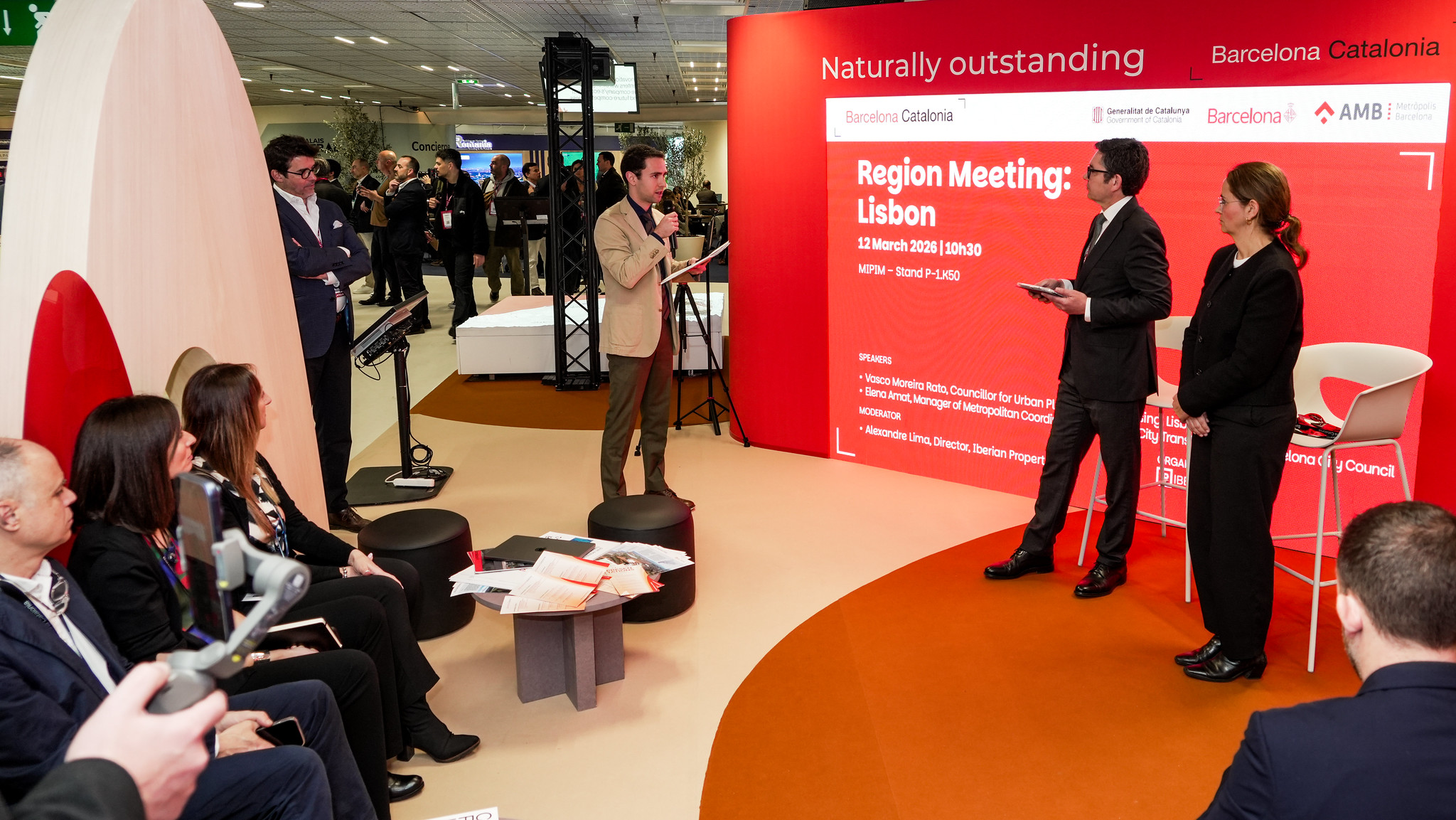
The morning opened with a dialogue between two cities that increasingly share similar urban challenges: Lisbon and Barcelona.
Moderated by Alexandre Lima, the discussion brought together Vasco Moreira Rato, Councillor for Urban Planning and Housing at the Lisbon City Council, and Elena Amat, Manager of Metropolitan Coordination and Major City Transformations at the Barcelona City Council.
Despite operating within different national frameworks, both cities face similar pressures linked to population growth, housing affordability and the need to maintain international competitiveness.
One of the first topics addressed was Lisbon’s position as Portugal’s capital city. According to Vasco Moreira Rato, the presence of national institutions, diplomatic representation and central government agencies naturally enhances the city’s international visibility and can facilitate investment promotion. However, he stressed that institutional status alone does not guarantee long-term success. Cities must continuously adapt to economic growth while ensuring that development benefits local residents. Managing housing affordability, urban regeneration and talent attraction therefore remains central to Lisbon’s strategy.
Urban transformation projects are an important part of that effort. The Lisbon councillor highlighted initiatives such as Unicorn Factory Lisboa, which has helped reposition former industrial areas into innovation districts supporting start-up activity and technology companies. Hosting the WEB Summit has been other of the big achievements highlighted as the openness of the city to foster dialogue and welcome foreign investors. At the same time, Lisbon continues to study international examples, including Barcelona’s 22@ District, widely recognised as one of Europe’s most ambitious urban regeneration programmes.
From Barcelona’s perspective, the strategic positioning differs. Elena Amat assured that the strength of the city's economic clusters, its global brand and the scale of its metropolitan region gather everything needed to become known by international investors. She further explained that Barcelona’s development strategy increasingly operates at the level of the broader metropolitan area, which encompasses 36 municipalities and around five million residents. Coordinating infrastructure, housing and economic activity across such a large territory inevitably adds complexity, but it also enables a more diversified urban system.
Land scarcity remains a particularly pressing challenge for Barcelona compared with Lisbon. Limited expansion corridors mean that urban planning must prioritise regeneration, density and the efficient use of existing land.
Housing affordability also emerged as a shared concern. Both cities are seeking ways to expand supply while maintaining conditions that allow private investment to remain viable. Achieving that balance is essential for attracting international capital while preserving social cohesion. Despite occasional competition for investment, Vasco Moreira Rato emphasised that cooperation across the Iberian Peninsula ultimately strengthens the region’s attractiveness. Investors prioritise stability and predictability, and stronger collaboration between cities such as Lisbon and Barcelona can reinforce the perception of Southern Europe as a reliable destination for long-term capital.
The conversation concluded by highlighting that both cities participate in Mayors for Housing, an alliance of 27 European cities working collectively to address housing shortages and advocate for stronger policy tools at the European level.
Parc de l’Alba: a science district shaping metropolitan growth
The following session focused on one of Catalonia’s most ambitious urban projects: Parc de l'Alba, presented by Carlos Cordón, Mayor of Cerdanyola del Vallès, in conversation with Ester Pujol, Director of Social and Economic Development at the Àrea Metropolitana de Barcelona (AMB).
Located just north of Barcelona, the project spans almost 400 hectares, making it one of the largest science-oriented urban developments in Southern Europe.
At the centre of the district stands the ALBA Synchrotron, a major scientific infrastructure already in operation and widely regarded as one of the most advanced research facilities in the Mediterranean.
For Catalonia’s development strategy, the synchrotron acts as a powerful anchor institution. By concentrating research infrastructure, academic institutions and private companies in the same area, policymakers aim to generate a critical mass capable of attracting laboratories, corporate R&D centres and technology start-ups. The project also benefits from its proximity to the Autonomous University of Barcelona and the Vallès Technology Park, creating a powerful innovation triangle linking research, education and business activity.
However, Parc de l’Alba is designed as far more than a research campus. The masterplan integrates housing, economic activity and environmental infrastructure into a single urban platform.
The development will include around 3,500 homes, many of them within public housing programmes, alongside 1.3 million square metres of space dedicated to economic activities. The objective is to create a balanced district where scientists, entrepreneurs and residents can live and work within the same environment. Green infrastructure also plays a major role - approximately 160 hectares will remain dedicated to green zones, preserving natural landscapes while connecting the district to surrounding ecosystems.
According to Cordón, the project is already moving from planning to implementation. Urbanisation works are underway across several areas of the development, with logistics plots already available for sale and land prepared for data centres and office buildings currently being marketed.
The next phase of development will focus on the residential component, reinforcing the ambition to transform the site into a fully integrated neighbourhood.
For Catalonia, Parc de l’Alba represents a flagship growth initiative that combines economic diversification with urban expansion. By integrating scientific infrastructure, housing and innovation activity, the district aims to strengthen the region’s knowledge economy while contributing to the wider metropolitan housing supply.

Catalonia’s logistics sector: growth, constraints and global competition
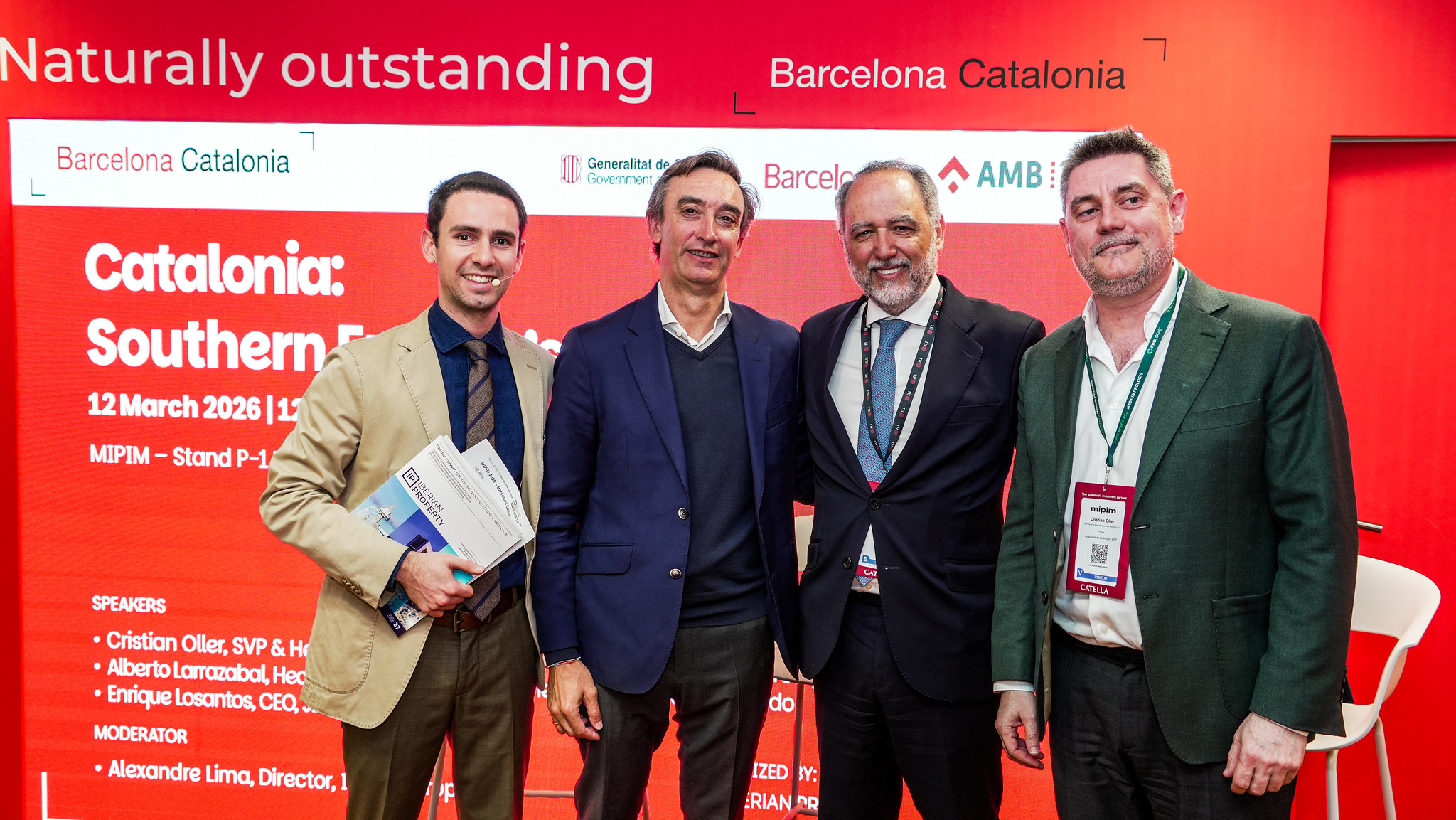
The final session of the programme turned to one of Catalonia’s most internationally competitive real estate sectors: logistics. The roundtable brought together Cristian Oller, SVP & Head of Asset Management for Southern Europe at Prologis, Alberto Larrazabal, Head of Investment and Business Development for Valfondo, and Enrique Losantos, CEO of JLL at Spain.
Catalonia’s logistics leadership is closely linked to its infrastructure network, particularly the Port of Barcelona, which acts as a critical gateway for international trade and supply chains. As Cristian Oller explained, this combination of port, rail, airport and highway connectivity makes Catalonia the leading logistics market in Spain. However, this success has also created new challenges.
The most pressing is land scarcity in the first logistics ring around Barcelona. Available space is extremely limited, creating a structural supply shortage that tend to push rents upward. While this scarcity benefits existing asset owners, it also encourages investors and occupiers to explore alternative locations such as Vallès, Tarragona and even Lleida.
From a capital markets perspective, Enrique Losantos noted that investment funds have been among the most active buyers in the region’s logistics sector. Many investors pursue a single-asset acquisition strategy and later aggregate properties into larger portfolios capable of attracting institutional buyers. However, assembling large-scale logistics platforms can be challenging due to fragmented land ownership and the limited availability of large development plots.
Sustainability requirements are also reshaping development strategies. According to Larrazabal, speculative logistics development has become more complex as ESG standards and energy requirements increase construction costs. Developers increasingly incorporate renewable energy systems, electrification infrastructure and advanced building technologies. In many cases, these investments are partially shared with tenants to ensure that sustainability upgrades can be reflected in rental structures. Another emerging constraint concerns electricity capacity.
Among the agreed topics by the Speakers, the need to modernise Catalonia’s older logistics stock and to strengthen collaboration between public authorities and private developers was ranked at the top of priorities for long-term competitiveness of the region. Some municipalities still perceive logistics buildings as low-value warehouses, despite the sector’s evolution into highly technological operational centres supporting employment, automation and sustainable transport systems.
The competitive landscape is also increasingly international. While Catalonia remains Spain’s main logistics hub, the sector now competes directly with fast-growing markets in Poland and Slovakia, where land availability and development costs are often lower.
Looking towards the next decade, the panelists broadly agreed that Catalonia is likely to remain one of Southern Europe’s most important logistics platforms. However, maintaining that position will require continued investment in infrastructure, faster permitting processes and stronger public-private coordination to unlock new development opportunities.
A closing perspective
As the Barcelona Catalonia programme concluded at MIPIM, the final sessions reinforced many of the themes that had emerged throughout the week.
From metropolitan cooperation between the cities that form part of Catalonia, but even with Iberian peers such as Lisbon, to science-driven, healthcare and life-science urban developments, the strategic importance of offices to retain talent, retail adding value and quality of life to existing and new spaces, and finally to logistics infrastructure, the discussions illustrated how Catalonia is approaching urban development through an integrated economic lens.
Rather than presenting isolated real estate projects, the region’s institutional platform has consistently emphasised the importance of linking urban planning, infrastructure and innovation ecosystems into coherent long-term strategies.
In an increasingly competitive European landscape, that capacity for coordination may ultimately prove to be one of Catalonia’s most valuable assets.
Iberian Property was proud to guide the debate that generated these insights over the course of the week, and soon a dedicated Special Story will be available, featuring exclusive video interview and more in-detail projects shaping the future of the region.

