




 76 / 110

76 // iberian.propery / 2017
dossier// ISSUE: TOP IBERIAN Investors
The road to Brexit:
what’s next for investors?
With the UK expected to start the process of leaving the EU this month, we asked
a panel of investment and economic experts covering a variety of areas, from real
estate to European equities, what they are looking out for in the coming months.
author:
Emma Stevenson
| Investment Writer at Schroeders
TheUKgovernment is expected to triggerArticle 50bytheendof thismonth,
signalling the start ofa two-yearprocess thatwillsee thecountryleave theEU.
The Brexit process started on 20 February 2016when then Prime Minister
David Cameron called a referendum on the UK’s membership of the EU.
The news saw a decline in the value of sterling, although stockmarkets
experienced a more muted reaction. External events, such as worries
over China’s economy, were also affecting markets in early 2016.
Additionally, the FTSE 100 is home to many international companies
operating in defensive sectors such as pharmaceuticals and tobacco.
These companies were in demand both because of their overseas earn-
ings and also the less economically-sensitive nature of their operations.
At the same time, commodity-related sectors such as oil & gas and
metals & mining also performedwell. Theywere viewed as being among
the chief beneficiaries of sterling weakness against the US dollar, with
commodities generally being priced in dollars.
Past performance is not aguide to future performance andmaynot be repeated.
A similar pattern was repeated on 24 June 2016, the morning after the
referendum, when it was confirmed that the “
Leave
” campaign had won
the day. Again, sterling moved lower but stockmarkets were less affected
than many had anticipated.
In part, the resilience of the UK stockmarket was due to investor appetite
for international stocks with foreign - particularly US dollar - earnings.
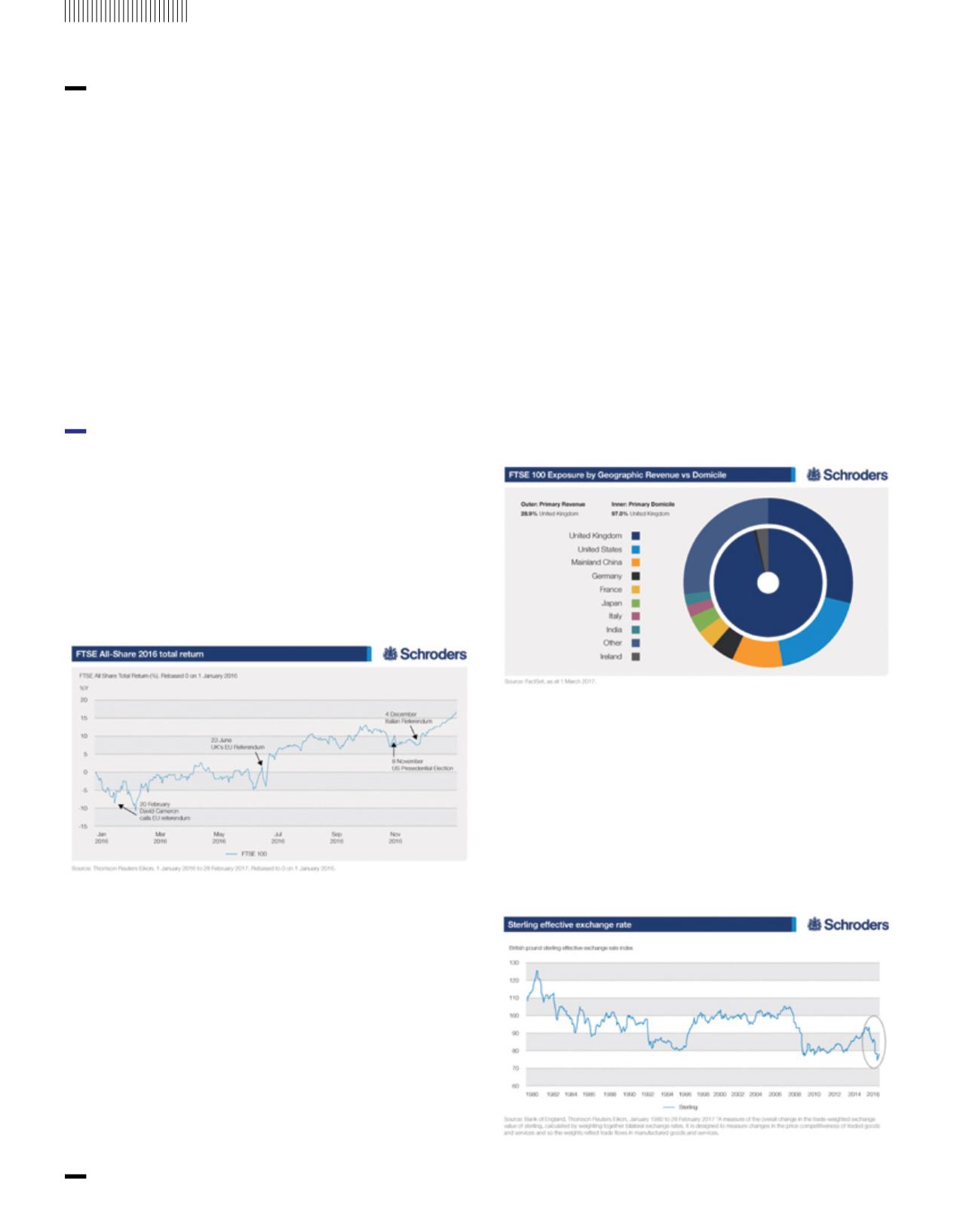
The chart below shows that the FTSE 100, the UK’s leading large cap
benchmark, generates only c.29% of its revenues from the UK.