
REAL ESTATE FINANCING WILL BECOME INCREASINGLY HYBRID

As risk management in the banking sector becomes more conservative, alternative financing solutions and capital markets are gaining prominence in the real estate industry. Quicker and more flexible, these vehicles have enabled operations that would otherwise never have left the drawing board, leading a growing number of players to choose hybrid financing solutions that are opening the property market up to new types of investors.
Indeed, this was one of the conclusions reached at the conference “Portuguese Real Estate Investment Vehicles & Financing”, which took place on April 16th in Lisbon. Organised by Iberian Property, this session welcomed around two hundred investors and decision-makers who, during the morning, were given first-hand insight into the structures and solutions currently available in Portugal for those who want to allocate their capital to real estate, whether through debt or equity.
Access all the presentations of the Portuguese Real Estate Investment Vehicles & Financing 2026:
“Today, investors have a wider range of vehicles at their disposal, which are aligned with different strategies and risk profiles. But access to capital remains vital to the property market, which is why understanding how to structure the best financing options available makes all the difference between a good project and an exceptional project”, emphasised Manuel Puerta da Costa, CEO of APAF (Portuguese Association of Financial Analysts), and Chairman of the Conference, at the opening session.
Portugal presents “a stable legal framework, quality assets and good returns”, and “continues to stand out as an increasingly appealing destination for international real estate investment. And, as happened before with the war in Ukraine, the current adverse geopolitical climate appears to be fuelling this situation once again. However, to keep growing and developing, we need to diversify the sources of investment, adopting greater transparency in governance and adapting to global trends”, he advised.

The Portuguese market is a safe haven in turbulent times
Despite macroeconomic forecasts indicating a downturn “due to developments in the global geopolitical scenario”, and anticipating “a rise in interest rates in the coming months, which will jeopardise financing conditions”, the Portuguese economy is expected to keep growing, concluded Helena Adegas, Member of the Board of Banco de Portugal. “Albeit at a slower rate than in recent years, the GDP will continue to increase: 1.8% this year, 1.6% in 2027 and 1.8% in 2028”. Inflation is due to rise to 2.8% in 2026, then dropping to 2% at the end of the forecast timeline. Nevertheless, Adegas does not expect any major changes in the property market in the near future, either in the residential or commercial segments.

“Even in a more volatile environment, the market outlook is still quite positive”, agrees Joana Fonseca, Head of Business Intelligence & Consultancy at Dils Portugal, underlining that “Portugal is increasingly on the radar of international investment”. And the figures sustain this optimism, indicating a y-o-y growth of 37% in real estate investment in the country in the first quarter, anticipating “that 2026 will end with a transaction volume at least in line with 2025”. Clearly dominating Portuguese capital markets, “international investment is four times higher than domestic investment, although the latest data show that domestic investors are increasingly dynamic”, this expert noted, adding that “in terms of investor profiles, most end up investing in core and value-add assets”. Compared with other European markets, “not only does Portuguese real estate offer investors solid returns in the short and medium term, but these also compare favourably with many European countries”, Fonseca added.
The fundamentals are robust, “there is capital on hand, and opportunities in almost every market segment”, however “volatility has become a part of our daily equation”, Joana Fonseca noted. Due to this, “investment strategies will become increasingly stringent and capital will become increasingly selective and demanding”, this expert at Dils predicts, adding that in this cycle “the rise in the value of the Portuguese property market will depend much more on the capacity to deliver, reposition and appreciate assets, than on the growth of rents or yield compression”.
Adaptability is a key asset
According to the economist João Carvalho das Neves, “real estate has a great capacity to adapt to circumstances. And what I see across different market segments is precisely this adaptability when macroeconomic conditions change”. Participating in the roundtable “Iberian Macroeconomics & Real Estate: Drivers of Growth and Emerging Risks”, Neves, who is also a professor at ISEG, presented a forecast of the impact of the war and increases in prices, oil costs and interest rates on the performance of sectors such as tourism and logistics, showing that the market is likely to respond quickly and adjust to new requirements from demand. “For example, in the hotel sector, if there is a drop in purchasing power, this will lead to a decline in demand, particularly in the 3- and 4-star segments. However, in the 5-star segment, Portugal may observe an increase from foreign demand, due to the country’s privileged geographic location. In logistics, another key sector, we may see major operators relocating to be even closer to their end customers, which may also affect investment”.
Pedro Coelho, CEO of Square AM, stated that “four major multinational tenants in the industrial and logistics sector contacted us recently to expand their space, also increasing the lease duration and rents”, and he believes that “this timing is not a coincidence, given the current international geopolitical scenario”.
A new cycle of asset appreciation and greater dispersal of capital
Recalling that the last decade brought “a new normal” to capital markets in Portugal, leading to average annual investment volumes of around 2 billion euros, the CEO of Square Asset Management is confident that market appreciation will maintain an upward trajectory. “Medium-term economic forecasts are more moderate, but real estate investment has longer cycles, and whenever there is inflation, there is asset appreciation. With rising international demand driven not only by investors, but also occupier companies, and inflation evolving in line with the ECB’s estimates, commercial rents are increasing, combined with yield stabilisation, which will cause asset prices to start rising as well”, Coelho believes.
Marlene Tavares, Head of Commercial Real Estate Investment at Dils Portugal, identified a growing geographic dispersal of investment among the trends that promise to shape the sector in the near future. “Although cities like Lisbon and Madrid continue to attract the largest share of capital, a closer look shows that capital is becoming increasingly dispersed across the map, with more capital allocated to secondary cities. And while up to now domestic investors had typically been those who paid more attention to those locations, we are now seeing increasing international investment also being channelled to secondary destinations”.

Growing demand for alternative financing
In an increasingly uncertain and ever-changing global market, with banks adopting a more stringent approach to risk management, real estate financing has also been changing, making room for new alternative models that have often proved decisive not only to make certain deals viable, but also to attract new investor profiles to the market.
Providing an overview of the principal alternative financing structures currently operating in the Iberian property market, Ricardo Reis, Partner of Deloitte, reveals that “in recent years, a growing number of investors have been seeking alternative sources of financing”, driven not only by the greater flexibility and risk tolerance of these structures, but also for reasons of tax efficiency and compliance, namely pertaining to ESG.
As one of the key lessons of the great recession, “credit risk management has become more cautious on the banking side, and this also led to the appearance of intermediate solutions, such as bridge-loans, for example”, this expert observes. And, more recently, “ESG has also affected how, based on their creditworthiness, investors prefer certain debt securities over others”, and “then, there is also the issue of tax efficiency”, he adds.
Noting that “we have made major progress in recent times”, Ricardo Reis also states that “there is no shortage of legislation in Portugal” in this field. “We have a range of instruments and legislation that enables us to implement almost all of the financing vehicles and solutions, and a tax framework that compares favourably with any other country, excluding offshores. But we also have our challenges, and the main difficulty is scale”, he advocates.
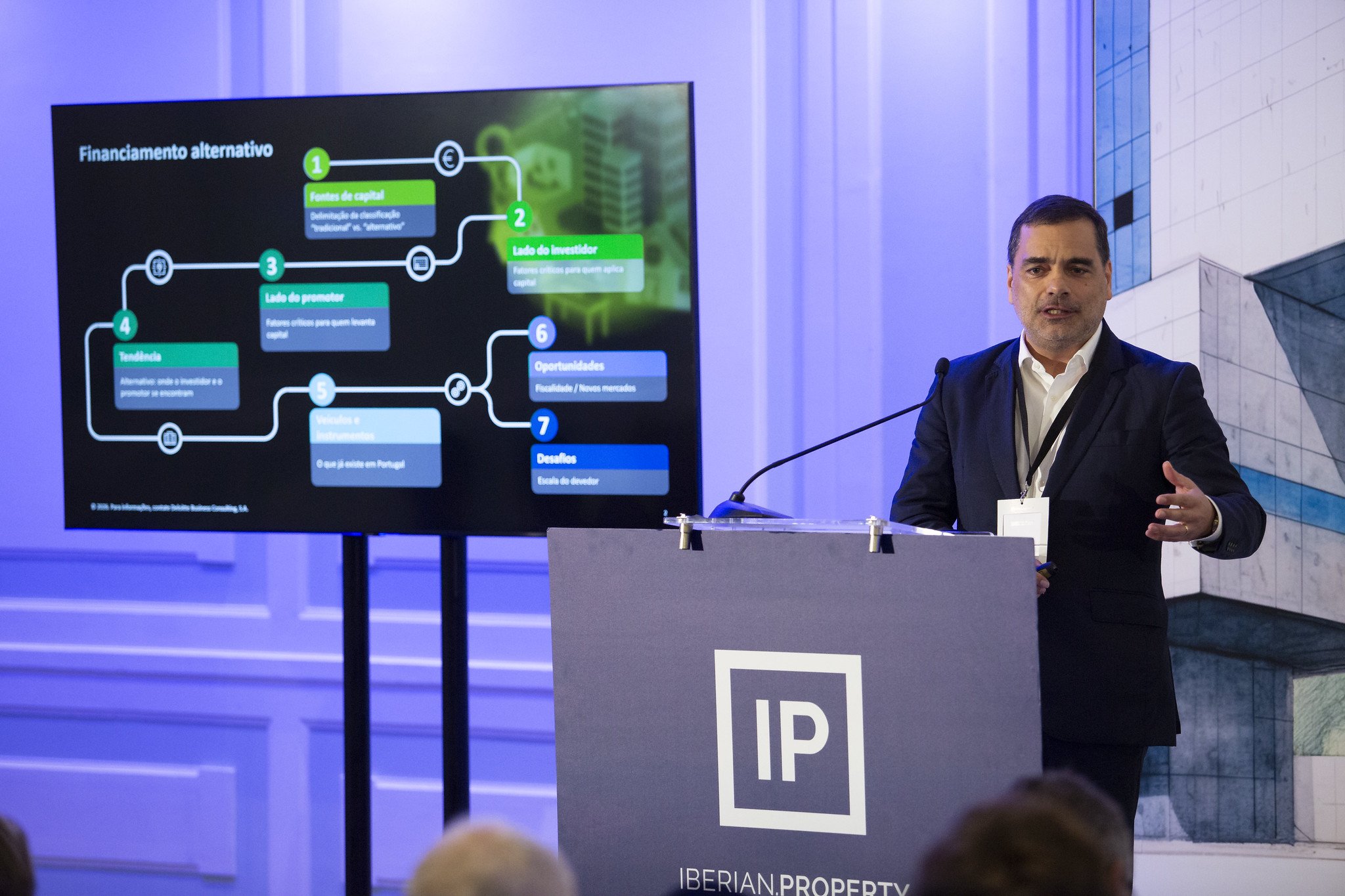
But the market still lacks scale...
Andrés Gonzaléz de Cominges, Managing Director, Head of Sales for Iberia Markets at CITI Bank, agrees with this opinion. “The Iberian market is still heavily dominated by local players, and I believe that this market’s appeal for major banks is more a question of scale – the size of the investment – than regulatory issues”, he stated. However, “due to increasing regulatory pressure, certain real estate segments and projects are no longer on the radar of traditional banks. And this makes room for alternative debt structures that, by taking on more risk, can leverage these investments”.
Defending that in capital markets “there is room for everyone: traditional and alternative lenders”, this CITI Bank head believes that “the ideal financing solution is hybrid”.
This is because, “comparing a traditional loan with different alternative debt sources is not that simple”, as recalls the CIO of Arrow Global Portugal, André David Nunes. Using bond issuance as an example, this expert explains that “this hasn’t really caught on in the market yet, but it could be a solution that gains more traction. However, when we compare the necessary requirements with those of a loan, we can see why alternative financing tends to be used for major transactions and by more sophisticated borrowers, and is not as widely adopted by a greater number of players”.
In any case, “over the last two decades, and especially since the Great Recession, the debt market has developed substantially, creating a greater and clearer distinction between traditional loans and alternative financing structures. Today, banks provide an important source of capital, usually at a lower cost than their competitors. But alternative lenders are particularly useful to leverage segments or stages of deals that banks typically no longer get involved in”, observed André David Nunes.
“The great recession taught us a lot, especially banks, which aim to become increasingly transparent and conservative in terms of leverage; therefore, they have stopped taking on as much risk and are now mitigating it. Of course, as alternative lenders are more flexible, their financing is also more expensive... and this is precisely why I believe there is room for all models; especially when they complement each other”, concludes Asier Uriarte, Investment Director at Izilend.

Investment contracts pave the way for a professional rental market
During the last panel of the day, “Mutual Fund Opportunities in Portugal’s New Housing Government Policy” were analysed by João Fitas and António Queiróz Martins, Managing Associates at Morais Leitão Law. “The framework for the planned investment contracts for Build-to-Rent, combined with the new tax benefits proposed by the Government for housing rental, could indeed kick-start this market in Portugal”, João Fitas believes. António Queiróz Martins considers the new measures recently announced and approved by the Government “a windfall of tax benefits”, which are positive and may drive the entry of more supply to the market. Nevertheless, these experts warn about the time limits on the application of some benefits, such as 6% VAT for housing construction, which may be a barrier for investment. Regarding the amendment of the law decree that regulates Collective Investment Schemes (CIS), “the news is quite encouraging”, Martins considers.

Ricardo Guimarães, Director of Confidencial Imobiliário, hopes that these new changes “will provide the necessary boost to stimulate the long-term rental market. We really need to create a rental market that addresses the current shortcomings in affordable housing. And not forget that our major funnel is the construction sector – prices also need to drop”.
According to Frederico Arruda, Partner at Refundos SGFII “we are on the right track to create a more profitable and functional rental market. Mainly because, until now, the professional rental market in Portugal has been virtually non-existent”. Nonetheless, Arruda believes that “the new system could go even further”, namely by implementing longer timelines, because “as investors, we plan our investments for the long term, and the regime currently being discussed has a short timeframe, therefore we don’t know what will happen when it ends”. This is why, “the fine print in investment contracts will be vital for this to succeed”.
Confirming the interest these vehicles generate among investors, especially institutional entities, Tatiana Rocha e Silva, Head of Operations at Insula Capital, also believes that “the conditions are in place to launch a professional rental market. Now the major challenge is to determine how we can speed up all the projects within a short timeframe”. Even so, “I believe that in three years we will have some success stories in this new market”.

A warm Thank You to our Partners
This Conference would not be possible without the trust and commitment of our partners. Our deepest thanks go to Arrow Global Portugal, Deloitte, Dils, Izilend, Morais Leitão, Refundos Explorer, and Square Asset Management.
A special word also for Insula Capital, and to the Associations that supported us: APAF, APFIPP, and APPII.