DIGITAL INFRASTRUCTURE AND SMART CITIES
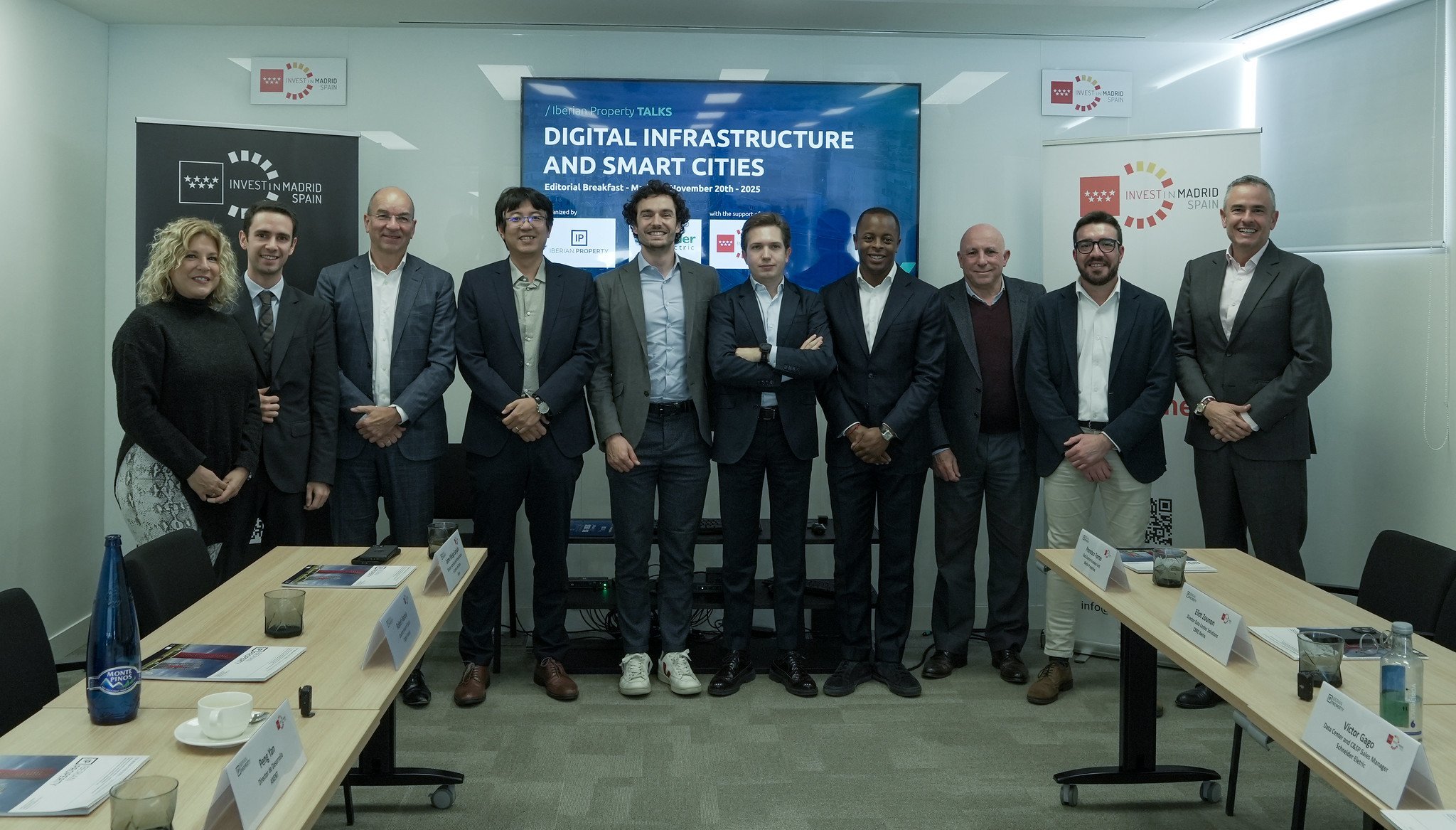
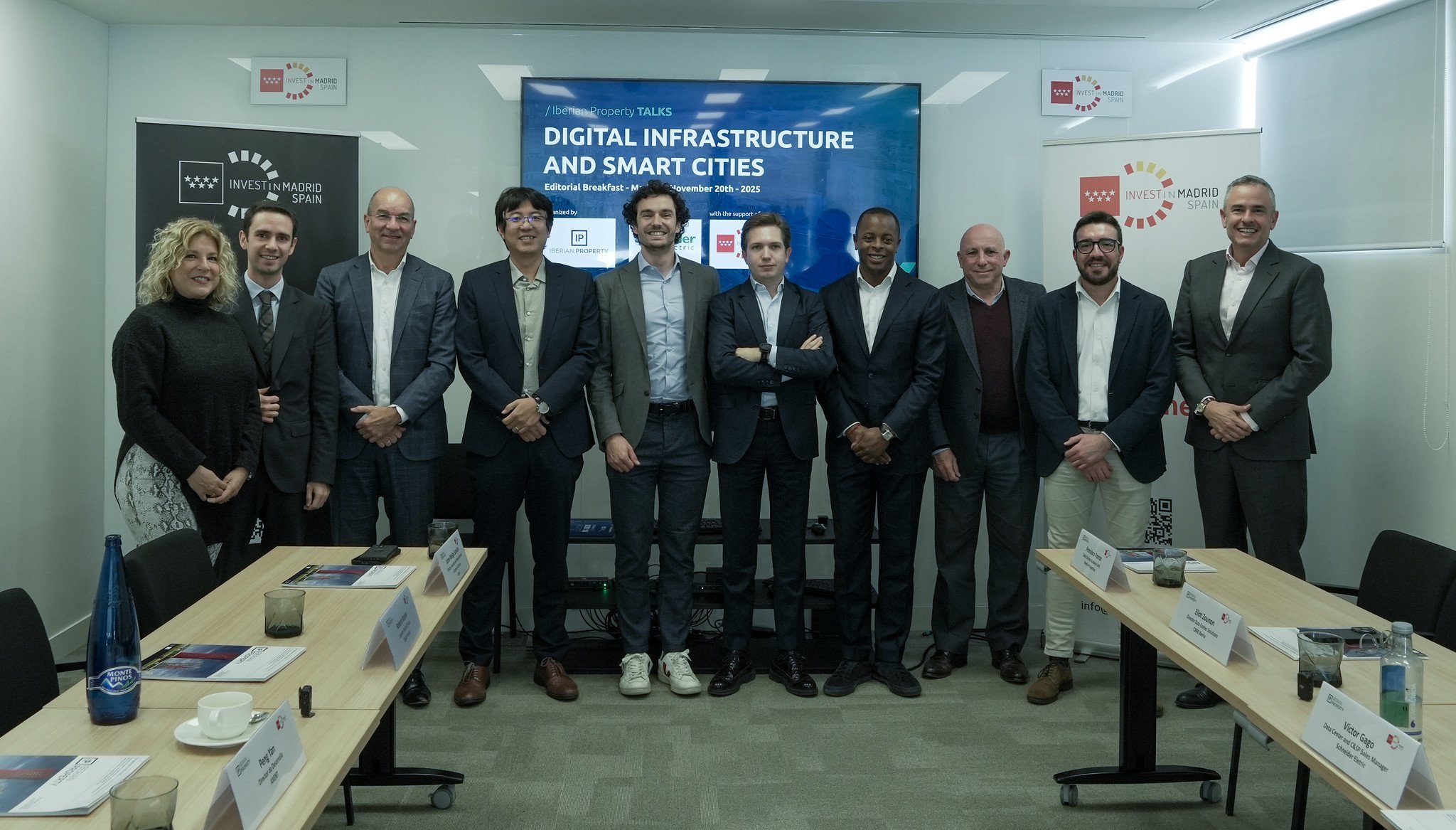
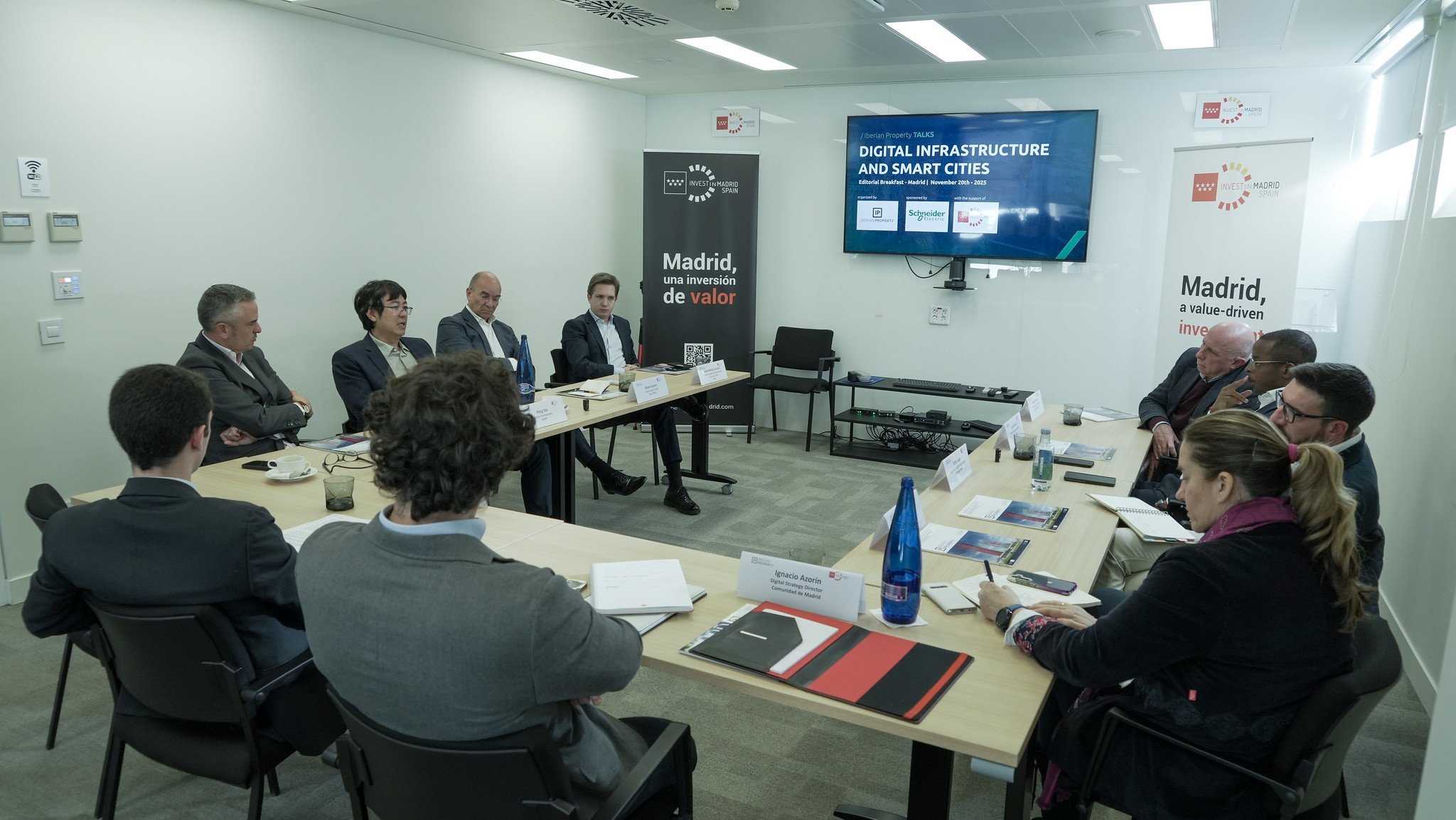
On the 20th of November, Iberian Property convened an Editorial Breakfast under the theme Digital Infrastructure and Smart Cities, hosted at the offices of Invest in Madrid — with the support of Schneider Electric. The session brought together investors, operators, policymakers and infrastructure specialists to explore Madrid’s emergence as a Southern European digital hub, and the opportunities and bottlenecks shaping the next wave of growth.
Opening the debate, Alexandre Lima, Director at Iberian Property, and moderator of this session, recalled two striking macro trends: global assets under management in infrastructure have multiplied nine-fold since 2010, while the projected global investment gap to 2040 still stands at around $15 trillion.
A market defined by exponential scale
Digital infrastructure is the sharp edge of this curve. In the past 15 years, global data creation — measured in zettabytes — has multiplied by a factor of 100, powered first by social media, then by streaming, and now decisively by artificial intelligence.
Against that backdrop, Madrid has rapidly positioned itself as a leading digital gateway in Southern Europe. But how?
According to Ignacio Azorín, Digital Strategy Director at the Comunidad de Madrid, explained that the region hasn’t suddenly created favourable policies to attract investment. What has happened is that the region has been following a consistent long-term roadmap for many years. “Our work in digital infrastructure, data centres and cloud began within an Industrial Plan revised in 2020 and which we have been implementing for quite some time. This continuity is what has allowed us to build digital infrastructure as a strategic asset that attracts investment”.
In terms of figures, Madrid currently has 35 operational data centres, representing 216 MW, plus 14 under construction, adding another 339 MW, and a pipeline of around 32 additional projects. With nuances, these represent roughly 2.5 GW of planned capacity, which is equivalent to half of Madrid’s current installed power. With these figures in mind, Ignacio Azorín highlighted that the challenge now is to distinguish between projects of real value, speculative developments, and those that truly align with our strategic objectives.
From a policy perspective, the priority has been making things simple for investors. “We are talking about very large amounts of capital, and if any uncertainty or friction arises, that capital leaves immediately for another country”. Therefore, Madrid created a fast-track policy framework, which works as an accelerator for strategic projects. This is also where Invest in Madrid plays a fundamental role. Thanks to this entity, Madrid has shifted from “attracting investment” to also helping existing investment grow and become sustainable.
This combination of strategic continuity and clarity has created the conditions that convince investors to come — and stay. And this applies across formats: yes, we are seeing a lot of hyperscale activity, but edge infrastructure is also essential in and around dense urban areas such as Madrid.
The Digital Strategy Director admits that there is still room for improvement. For example, the time to market must accelerate. “Reaching the dream scenario of 18–24 months from land identification to operation would be ideal, and we are still slightly short of that target. But from a policy standpoint, we are doing things well: when capital arrives, we are able to channel it efficiently, bring clarity and stability, and help projects progress faster”. Even if public administration is complex by nature, knowing what to expect already helps enormously.
Luis Socías, Director of Invest in Madrid, added that investment attraction strategic priority for the region, and being a gateway for capital means not stigmatising those who want to invest. “We want them all. In fact, we work with two types of clients: those who are already here and we want to help continue growing, and those who are not yet here. That is why we attend international fairs, support events like this breakfast, promote dialogue and listen closely to what the sector needs”.
Invest in Madrid wants to stay close to high value-added activity, and data centres are increasingly recognised as a sector that creates real value — even if some portray them negatively for not generating enough direct employment. “From our perspective, that is a very narrow way of looking at the reality. The true value is not only the jobs created by the facility itself, but the industries and services enabled by low latency and digital infrastructure: that is where the major impact is generated, in terms of companies, productivity and employment”, Luis Socias commented.
He further noted that Invest in Madrid focus on information and viable communication is leading to several advanced partnerships, such as a recently announced project with Cloudera, which will have concrete applications across education, transport and healthcare.

“Storing information is easy — the value is in its ability to travel between points”.
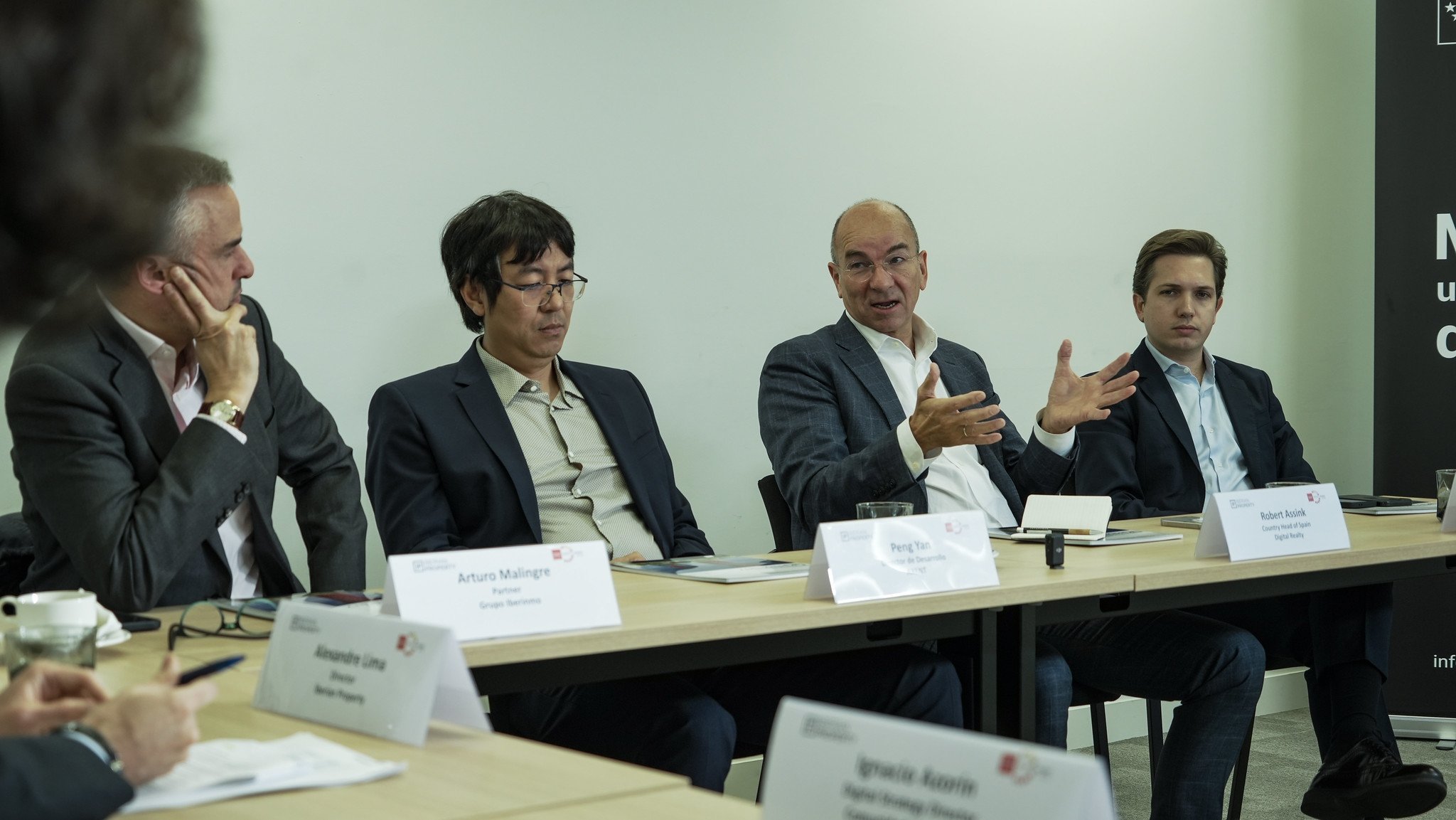
Robert Assink, Country Head of Spain at Digital Realty, shared the company’s trajectory in Spain, a history of 26 years, which according to him in many ways helped creating the colocation data centre market here. In the beginning, the American REIT focused on enabling network interconnection in a neutral space that supported the liberalisation of the telecommunications market. This was before the internet was widespread; the exchange of traffic was mainly voice, not data. At that time, interconnecting networks was slow and bureaucratic. “A neutral, independent physical meeting point, where operators could connect in minutes rather than months, was revolutionary. That is how the concept of the carrier-neutral data centre emerged”.
As technology evolved, internet traffic exploded. Voice became voice-over-IP, and digital services were created over that connectivity layer. Data is useless if it cannot move. “Storing information is easy — the value is in its ability to travel between points. That need for fast, reliable movement of data became the engine of our growth”.
In Spain, each phase of the market brought a different wave of demand: first, telecom liberalisation; then internet platforms, digital media and gaming; then, during the 2008–2012 crisis, enterprise outsourcing — public and private companies shifting from capex to opex. After that came the cloud-on-ramps era, with Spanish companies needing direct access to cloud platforms hosted abroad. And from 2020 onwards we began to see the large global investment announcements — Amazon building in Aragón, global cloud platforms seeking colocation partners, and now AI workloads, especially GPU-based infrastructure, driving a new kind of scale.
Different demand types have created different data-centre models. Digital Realty emerged as a multi-tenant operator — many clients under one roof. “To give an idea: across our four data centres in Madrid, spread across three locations connected by fibre, we have 17,000 cross-connections between customers. These allow them to buy and sell traffic and services directly with each other. It is like a digital airport hub — the density of connections creates value. This is not a single building with a single client: it is an ecosystem developed over 25 years, and you cannot build that overnight”.
Looking forward, Robert Assink points out AI as the clear main driver. “In 2023, we signed a single contract equivalent to all the capacity we sold in the previous ten years combined — for AI and cloud computing from the same customer. But even then, we deliberately chose not to sell all capacity to one buyer, in order to preserve the value of interconnection for the wider ecosystem”.
Where will demand go next? Studies forecast that by the end of the year around one-third of future power demand for data centres globally will still be non-AI. Much of that is inference, which can be slightly further from the city, but the bulk — especially high-density inference — must remain close to population centres, GDP concentration and the core economy. “In the Iberian Peninsula, that means Madrid and Barcelona. We are also evaluating Lisbon. We receive many proposals to go to remote areas that offer nothing except electrical power — but power alone doesn’t make a data centre ecosystem”, the Digital Realty representative concluded.
How does a commercial real estate investor transition into infrastructure?
Digital Realty and Merlin Properties share many features: on the one hand, they are both REITs, and on the other hand, they are both long-term holders. Francisco Porras, Data Centres Business Unit at Merlin Properties, argued that “many funds enter the sector to build and sell — which would have been the logical route for us if a ready-made platform had existed. But because it didn’t, we had to develop it ourselves”. Merlin’s portfolio was built asset by asset, so its strategy in data centres is very much build-to-hold oriented, consistent with its structure as a REIT/Socimi focused on rental income.
The key difference for Francisco Porras is horizon. “I look at this market over 20–30 years, not over 5. That time frame is what allows us to take risk. A five-year fund could never have absorbed what happened to us in Getafe, for instance, where power did not arrive when expected”. Yet, on the other side, Merlin Properties leased Barcelona and Álava immediately, which compensated that delay. If it had only backed one site, as a typical fund might, the company would have suffered a major setback.
The socimi entry into data centres followed the sale of the TRI portfolio leased to BBVA. Inflation and interest rates made those assets increasingly expensive for the tenant, so Merlin took the opportunity to exit at a fair value, reduced leverage significantly to around 30%, and still had capital left. “We had a responsibility to redeploy that capital for shareholders and we identified early the opportunity to diversify, at a moment when logistics was becoming crowded”. And importantly, this does not mean Merlin will abandon its core sectors — but we could not enter this with small moves: shareholder pressure means we had to scale from day one, underlined Francisco Porras. It should be recalled that Merlin’s ambition is to have 200 MW placed by 2027.
Another acknowledged challenge was that Madrid does not have infinite power. Ideally, Merlin would have concentrated everything around Madrid, near its team and universities, but available power pushed them south. “Even in an industrial estate, administrative hurdles are significant: we waited 1.5 months just for the line permit, and 11 months for environmental approval in an already developed industrial zone. This illustrates how demanding development is”.
Furthermore, the Data Centres Business Unit originally thought hyperscalers would be the primary tenants. But not long after they announced their own build programmes. “Fortunately, the AI wave arrived with tailwinds and enabled us to specialise in a niche: training of large AI models, which requires enormous power and highly sophisticated fibre connectivity. From Barcelona we serve Europe, and from Álava we serve the US. These are not local workloads — and this is a crucial difference”.
This niche demands huge power density, proximity to subsea cables, extreme scalability and the ability to expand rapidly. For that reason the socimi announced the Extremadura project, initially considered ambitious, but already attracting interest. AI operators do not want fragmented footprints — they want large, continuous blocks of power.
In practice, this is a role that should naturally be supported by institutional planning. Other European countries have prepared large, pre-equipped zones for digital infrastructure. “Here, we must assemble everything ourselves — land, planning, fibre, substation, permits — and that takes three or four years before construction even begins. Internationally this hinders our position as we are performing part of the industrial groundwork that elsewhere would be public”, Francisco Porras recognized.
That is why Merlin is gradually becoming an industrial company — it now hires more engineers than economists or lawyers. Each new data centre is different because technology evolves in 6–8 month cycles. And to play in AI today, you must adapt constantly — technically, operationally and strategically.
What makes Iberia resilient — energy mix, land availability, institutional support, or something else?
Everything ultimately points to the same conclusion. Across Europe there are multiple factors influencing where investors choose to deploy capital, but there is one dimension that must not be ignored: time. Markets evolve over long cycles. Eliot Zounon, Director Data Center Solutions at CBRE Iberia, stated that we often try to compare Spain directly with the FLAP-D hubs, but those markets have a 20-year history. They are mature ecosystems, shaped around financial activity — Frankfurt, London, Amsterdam, Paris and Dublin — and also influenced by fiscal policy.
What we are entering now is a new phase: a social use of data. Today, you no longer need a bank to build an entire digital infrastructure in order for communication to happen. Communication happens between all of us. This shift, together with the acceleration caused by the lockdown in 2020, marked a turning point in data consumption — and, consequently, in the growth of the data centre sector. This is what allows us to compare Tier-2 markets (outside FLAP-D) with the core hubs.
Still, it is difficult to compete in four or five years with markets that have been building for 25. Especially when we are speaking about infrastructure.
The business is no longer just about hosting corporate IT and allowing enterprises to interconnect. It is diversifying toward training AI models, which creates completely new value. And at European level, the new tenants — the ones who make this market sustainable — care enormously about access to energy. It is their major opex, and they want renewable power for sustainability reasons but also at competitive prices.
And here is where Iberia has a structural advantage: plentiful renewable energy at competitive cost. France benefits from stable nuclear power, the Nordics from abundant low-cost renewables. London continues to grow not because it is cheap, but because the digital infrastructure is already built and ready for scale.
The Nordics attract investment due to ease of doing business and fewer administrative hurdles. The demand coming into Spain, however, is driven by energy, but also by a mature and credible real estate market, where investors have confidence and data.

"Electricity cost is secondary, what matters is power availability"
For Digital Realty, (to date) the cost of electricity has not been the determining factor in deciding where to build data centres. "If I compare our operating realities across Europe, Germany has the highest unit cost of electricity and yet it remains the largest market. In our case, electricity represents between 15% and 20% of operating costs, depending on the site. So within the segment in which we operate, energy cost has not historically been decisive in selecting a location", commented Robert Assink.
As for Merlin, Francisco Porras justified it depends heavily on the client profile. "We host customers running machines at extremely high intensity — supercomputers. Visiting clients in Miranda I saw racks that cost €3 million each. If those machines are not operating at 80–90% utilisation, their business model collapses". These are AI factories, producing tokens to train models, similar in many ways to Bitcoin mining. To amortise that capex — and they replace machines more or less every six years — they must run flat out.
Electricity does drive operational life and time-to-market. The sooner they generate revenue, the better. But right now, for this niche, electricity cost is secondary. What matters is power availability. In the long run, for long-term holders, once the market matures, energy cost will matter more for expansion decisions. But today, in this phase, demand will flow to wherever there is available capacity.
Alexandre Lima highlighted the scale of innovation now shaping location strategy in the data centre industry, referring to recent announcements such as Jeff Bezos’ ambition to build data centres in space, and, at the other extreme, the launch of the world’s first commercial underwater data centre in China. These moves are motivated by scalling sustainability and energy efficiency, two topics which Víctor Gago, Data Center & C&SP Sales Manager at Schneider Electric, reasons having surpassed land availability as a criteria on the investment decision check-list. Time and energy have become the decisive factors. Schneider Electric recognises public-sector efforts to shorten permitting timelines in several regions of Spain, but there is another timeline that is just as critical: construction itself.

“The available megawatt must be maximised for the client, and construction needs to be designed with that in mind. Improving energy efficiency is vital — not simply to reduce cost, but to increase usable power for clients”. This is particularly visible in cooling systems, which are increasingly liquid-based and enclosed, offering much higher efficiency than traditional air cooling.
The pressure is immense: we are moving from considering 160 MW racks as advanced, to Nvidia planning 1 GW racks, which forces continuous innovation to maximise performance. “Modular construction, which was barely considered a few years ago, has now become standard in almost every current project. It offers flexibility to adapt to technological advances — and crucially, helps reduce construction times”, Víctor Gago argued.
How can investors mitigate obsolescence & reputational risks?
Jaime Mielgo Sanjuán, Associate Director of Infrastructure and Data Centres at Azora, began by underlining the type of investor Azora is. Often labelled as a real estate investor, in reality the company is an investor in real assets. “Over the past decade, for example, we have developed two gigawatts of traditional renewables, and we had such conviction in the energy transition that we deployed our own balance sheet, not institutional capital”. That experience is what has enabled Azora to move into data centres.
Starting from that foundation, Azora chose to strengthen itself mainly on technical expertise, building a knowledge base organically and inorganically. Regarding the strategy, flexibility was (and is) a key mitigant against obsolescence.
“The pace of change in this sector is extraordinary — I don’t think there is any other real asset with a comparable rate of technological evolution. We build for today’s requirements, but always with a long-term mindset. Nobody has a crystal ball, but you must design based on the trends you see coming”.
This means imagining and anticipating tomorrow’s needs: structural load capacity, for example, becomes critical as equipment becomes heavier and more power-dense per square metre. The same applies to space between floors, to accommodate liquid cooling today — but with the capacity to handle much higher future flow rates should we move towards gigawatt-scale campuses, the expert reasoned.
"If we fail to attract this industry, it will develop elsewhere and we will still consume its services — only the economic value will be generated abroad”
On the reputational side — Jaime Sanjuán believes the industry has been too slow in shaping the narrative. Critics have been quicker in framing data centres negatively: as low-employment, high-consumption, unsustainable assets. “It is ironic that this is the only industry judged by what it consumes, not by what it creates. When a car plant is announced, nobody calculates how many tonnes of aluminium it will use or how much CO₂ it will emit — we hear about investment, jobs and growth”.
We must communicate the positive impact: economic activity, productivity, innovation, indirect employment and clustering effects. “And we need to articulate a clear message: if we fail to attract this industry, it will develop elsewhere and we will still consume its services — only the economic value will be generated abroad”.
Spain has a unique window: abundant renewable energy, strong fibre penetration and access to subsea cables. It must seize it with ambition.
Contributing from a different angle, Peng Yan, Commercial and Development Director at Axent, explained that while the company is neither a real estate developer nor an energy operator, it is deeply embedded in the digital infrastructure value chain. Axent is a carrier-neutral wholesale operator whose core business is connectivity. Rather than providing FTTH services to end users, Axent enables telecom operators to build and expand their backbone and core networks, which has been the company’s traditional activity.
Peng stressed that data centres have connectivity requirements that bear no resemblance to those of residential networks. They demand ultra-low latency, extremely high bandwidth and stringent availability guarantees, which is precisely where Axent focuses its efforts today.
The company was established in 2018, backed by infrastructure funds and the industrial shareholder Enagás, a combination that explains why Axent’s network is fully buried and enjoys a reinforced level of resilience and protection. That same year, the MAREA subsea cable landed in Spain, and shortly afterwards AWS announced its cloud region in Zaragoza. This, according to Peng, was a turning point. "Spain had not received a new submarine cable in decades, and suddenly hyperscalers began investing heavily. This shift created the need for new routes, higher redundancy and new technical standards. Axent positioned itself to respond to that demand and to enhance the attractiveness of emerging hubs such as Barcelona, thanks to its subsea connectivity, and Bilbao".
"No one can state with certainty what traffic requirements will look like across the next technological cycle".
Looking ahead, Peng explained that Axent is seeing constant requests from data-centre developers looking for capacity and assistance in route design. Beyond access to land and electricity, reliable connectivity is becoming a decisive factor in site selection. A data centre without robust fibre, he noted, is effectively an isolated facility, unable to support high-density cloud and AI workloads. "Without the ability to move data, no amount of installed capacity is meaningful".
He also highlighted what he considers the most difficult variable: no one in the industry can accurately predict data volumes five years from now. Five years ago, he argued, few foresaw the acceleration of AI in the way it is happening today. And today, no one can state with certainty what traffic requirements will look like across the next technological cycle. That uncertainty is structural.
For that reason, scalability can no longer be an afterthought. It must be designed into infrastructure from the beginning. Historically, Axent deployed 32-pair fibre cables, and these already seemed oversized. Now, however, the company is installing 144-pair and even 256-pair systems as a matter of course, because the market may require exponentially more bandwidth at a moment’s notice.

Lease contracts: a thin balance between stability and adaptability.
For Digital Realty the model is quite straightforward: everything is highly standardised with full end-to-end processes. "We work with a master Service Level Agreement that defines the technical and service standards, and in around 90% of cases clients sign the standard version", granted Robert Assink. Only very large global clients require adaptations to local CPI indexation, jurisdiction, or global risk policies.
Clients can choose usually between three-, five- or ten-year terms, with automatic renewal options if they want them. But importantly, "we are not selling power density or a specific engineering configuration — we are selling a service level. How we technically deliver that service is secondary for most clients. When it’s Huawei or Microsoft, the conversation is different, but in the vast majority of cases the value proposition is the service, not the engineering design".
Francisco Porras confessed that he wished Merlin could have a similar structure, but the truth is that every client requires a bespoke solution inside the data centre. Often those are technically complex requirements, with heavy contractual and legal implications, and service levels that depend not only on the company, but also on third-party infrastructure.
“As a SOCIMI the challenge is even greater, because our model is fundamentally rental income, not ancillary services. We are obliged to convert revenue into euros-per-square-metre, even though our underlying business driver is megawatts”. Unlike a global colocation operator, Merlin cannot monetise cross-connects, network services or other sub-products that would naturally sit around the asset. That forces creativity in contractual structure: through clauses, uplift mechanisms and indexation it translates a complex service into a compliant rental framework. Merlin has succeeded in doing that so far, but it is not straightforward.
Another difficulty is that—unlike mature hubs—Merlin cannot rely on pre-existing ecosystem synergies. “There are efficiency gains that come from developing at scale and within concentrated clusters, unfortunately in Spain we did not have a large, pre-planned campus ecosystem to plug into. So, we have needed to build incrementally, region by region, often in locations where grid availability exists but support infrastructure still has to be assembled project-by-project”. This requires to take on work that is not traditionally the landlord’s role: helping clients secure long-term PPAs (power purchase agreements), coordinating talent pipelines with universities, establishing partnerships to support specialised operations, and anticipating their future expansion needs.
“Ultimately, for us the critical objective is not only attracting tenants, but retaining them and enabling sustained growth. In a global, location-agnostic market, Merlin must ensure that when a client grows by 100MW, 80MW of that growth happens with us”. That, Francisco Porras explained, means customised contracting, energy support, and building the wider ecosystem that will allow Spain—and its assets within it—to scale competitively over time.
This is a fast-moving industry: decisions on location and investment are being made in weeks, not years, and whoever secures strategic positions now will gain the long-term advantage. "We have seen inspiring examples elsewhere — in Norway, for instance, high figures of the Royal family actively engage with global technology companies to understand their needs and facilitate investment".
The administration itself encounters barriers... internally, the obstacle is not political will.
First, it’s important to understand the perspective from which a regional administration can realistically operate – what it can do, and what sits beyond its control. Energy policy, for instance, is a major limiting factor. “We work with the cards we are given by the national grid operator. Investors submit power requests, but we must assess which projects add strategic value, and which are speculative or unfeasible”, reflected Ignacio Azorín. At this moment in Madrid, power requests already represent the equivalent of half of the region’s entire installed capacity. Managing expectations alone is a challenge.
The administration receives clear signals from the market: some large-scale proposals in peripheral areas may never materialise, while the long-term fundamentals still point towards Madrid and Barcelona.
On the energy map, Madrid analyses in real-time where renewable generation connects to the region: Solaria along the A-2 corridor, Statkraft around Boadilla, and the Alcalá belt and Madrid south completing the main routes of projects. In aggregate, this represents gigawatts of potential, albeit highly dispersed. “The ideal scenario would indeed be a single major hub with massive pre-built capacity — but deploying that requires tools we do not yet have. The honest question we face internally is: how do we do that today, with today’s instruments?”
On planning and permitting, the reality is that Madrid has created an investment fast-track structure which did not exist before. “In theory, we have cut administrative times by half. In practice, we still collide with layers of environmental assessments and procedures which were never designed for this type of asset”.
Internally, the obstacle is not political will — the challenge is coordination. “For every data centre, we must move simultaneously with Circular Economy, Environment, Urban Planning, Roads, Hydrographic Confederations, and several other departments. Each has its own criteria, deadlines and requirements”. A single ecological factor — like a seasonal lagoon affecting a route to Alcalá de Henares — can stall an entire project.

Ignacio Azorín agrees that agility must be improved. He even stressed Aragón’s progress on this front. “We now have a clear internal objective: approach a 24-month delivery horizon, and eventually the 18-month market benchmark. If we achieve that, there will be no reason for Madrid to lose projects to other regions — except when power availability makes it unavoidable”.
Both Merlin Properties and Digital Realty underscored that the energy challenge is structural and extends far beyond investors’ control. Francisco Porras pointed out that Madrid generates barely 4% of the power it consumes, and that the region must prioritise not only data centres, but also homes and industry. He stressed that operators depend heavily on the national grid and central government, and noted that while renewables help reduce costs, their intermittency limits operational certainty. In his view, only nuclear can provide the level of reliability these facilities demand.
By contrast, Robert Assink emphasised Digital Realty’s desire not to become an energy strategist at all, remarking that the company has effectively been forced into that role: “we just want to build and connect facilities, like a developer plugging into an electrical cabinet when building a house.” Together, their comments reflect a shared frustration: operators are being pushed into solving energy issues that should sit at system level, rather than at asset level.
"Data Centers investors do not wish to be energy specialists, they have been forced into that role"
Jaime Mielgo Sanjuán, provided a last straightforward solution to Spain’s structural energy challenge. "Storage is what allows a system to integrate a far greater share of renewable generation, and countries such as the UK or Germany are already far ahead in regulatory frameworks that support it". The problem in Spain is the absence of a remuneration model for batteries. These assets have two income streams: one derived from intraday price volatility, and another from capacity payments, which compensate batteries for the system services they provide — smoothing intraday price differentials and reinforcing grid stability. Until Spain develops a regulatory and remuneration framework for storage, it will be unable to absorb a higher volume of renewable energy. Today, the country has around 140 GW of installed capacity and a further 140 GW of renewable projects with access and connection rights. "Yet almost none of this pipeline will be built, except wind, because daytime negative pricing renders most projects unviable. Storage therefore becomes essential. Beyond batteries, however, a second bottleneck remains: transmission infrastructure. The regulatory framework governing grid expansion is outdated and lacks the flexibility the industry now requires". Local permitting for substations and transmission assets can take years, which means that without modernised rules and accelerated approvals, the system will be unable to deliver the energy the market demands.
As the discussion drew to a close, the Madrid’s Digital Strategy Director offered a candid reflection on the challenges ahead. Madrid has proven its capacity to scale – live data-centre capacity has increased almost 90% in recent years – yet the next phase requires clearer strategic signalling: where should the cluster grow, which projects add value, and how can institutions reduce uncertainty for serious, long-term investors? For the region, he argued, the goal is not to remain debating data centres in five years, but to have the foundational infrastructure in place – power, planning, skills – so that Madrid can tackle the next frontier.
The private sector side final "wish-list" included a unified national framework to consolidate permitting across administrations, and higher procedural agility compared with markets where silence implies approval – not rejection.