


Spain’s affordable housing sector is entering a decisive new phase. After a decade marked by rising rents, limited supply and fragmented policy responses, momentum is building behind a more coordinated strategy — and long-term institutional capital is preparing to play a central role.
A new report from Octopus Capital, its first since establishing a permanent office in Madrid last year, examines this inflection point in detail. Drawing on industry research, local stakeholder engagement and its own experience in the UK’s specialist living sectors, the firm outlines why Spain is poised to become one of Europe’s next major opportunities for impact-led residential investment.
A widening gap between incomes and housing costs
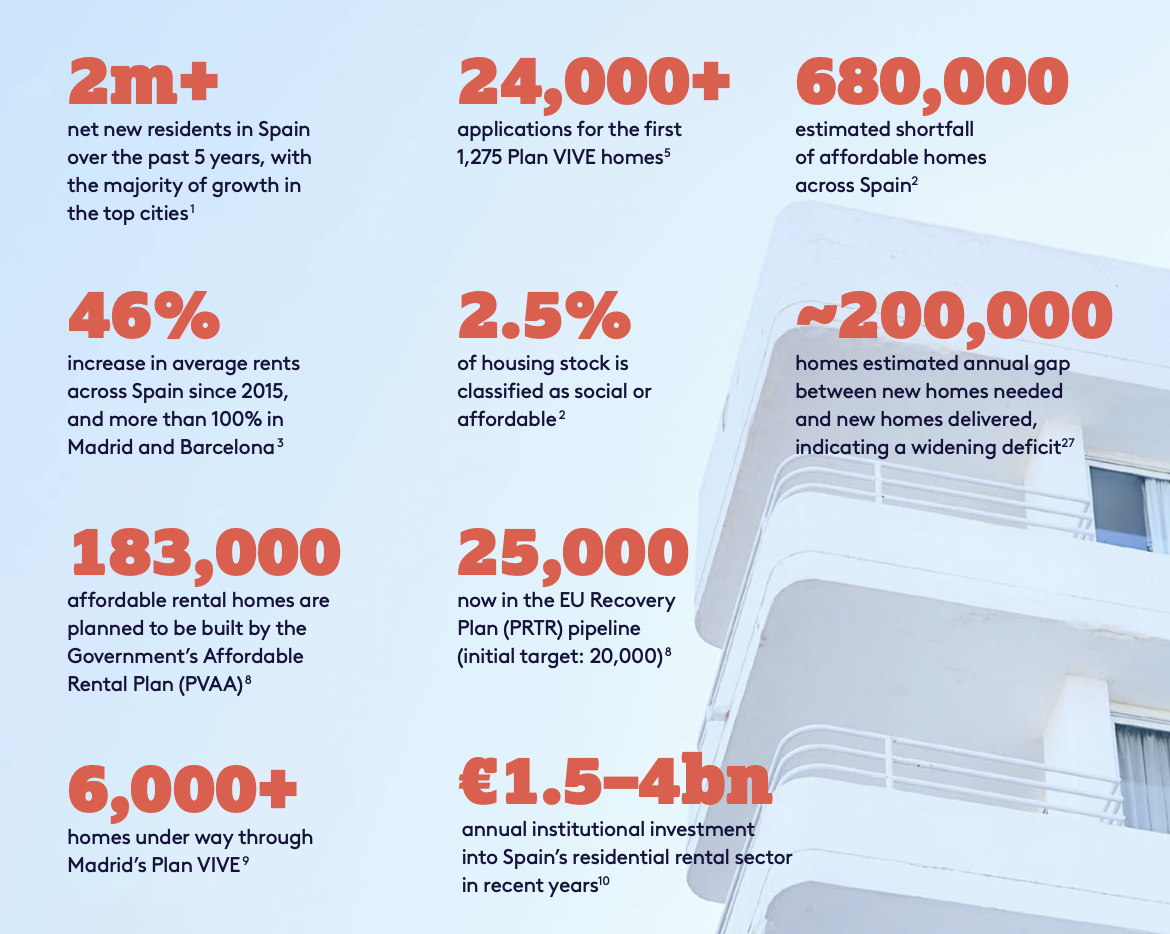
The report underlines the scale of the structural misalignment in Spain’s housing market. In parts of the country, rents have nearly doubled over the past decade, while wages have grown by around 20%. This imbalance — together with the fact that more than 80% of young adults remain in the family home — is a key contributor to affordability stress across major urban centres.
At the same time, demand continues to outpace supply. In 2022 Spain registered more than 800,000 new residents, the fastest population growth in more than ten years, concentrated largely in cities and coastal regions where housing shortages are already acute. Yet new-build delivery remains well below need: fewer than 100,000 homes were completed in 2023, against an estimated annual requirement of 300,000. The cumulative deficit could reach 680,000 units by year-end.
Financing pressures and fragmented planning frameworks
Spain is not alone in contending with higher debt costs, construction inflation and tight labour markets — all factors that compress viability for developers and increase the equity required to bring schemes forward. But its planning regime adds a further layer of complexity. With 17 autonomous communities each setting their own rules, national-scale rollout is challenging and timelines can be unpredictable.
Despite this, certain regions are demonstrating how more consistent, transparent structures can unlock private investment. Madrid’s Plan VIVE — which offers long-term concessions on public land to deliver affordable rental homes — is highlighted as a model with strong replicability: more than 6,000 homes are underway and the total programme aims for 25,000. Demand has been extraordinary, with more than 24,000 applications for the first 1,275 units alone.
A favourable macro backdrop for long-term capital
Where Spain stands out in the European context is in its macro and demographic fundamentals. Its economy has proven resilient, its urban markets are deep, and rental demand is structurally solid. Investors have taken note: Spain ranked second in Europe for real-estate investment attractiveness in 2025, behind only the UK.
The report argues that these dynamics are beginning to outweigh the traditional constraints — particularly as new national and EU-level initiatives expand the pipeline. Spain’s Affordable Rental Plan (PVAA), the accelerated mobilisation of state-owned land through SEPES and Sareb, and additional funding via the EU Recovery Plan all point toward a more coordinated push on supply. Meanwhile, the European Commission’s new Affordable Housing Dialogue signals a long-term policy shift, including planned changes to state-aid treatment and a potential pan-European investment platform.
Lessons from the UK: affordability, energy performance and long-term alignment
Octopus Capital draws parallels with its UK experience, where it manages over 10,000 beds across specialist living sectors and has raised more than €400 million for affordable housing. The firm’s UK portfolios demonstrate how long-term capital can deliver both stable returns and measurable impact when schemes are designed around energy efficiency, quality and predictable rental structures.
Its Zero Bills home model — combining fabric-first construction with onsite solar and battery systems — is one example of how innovation can simultaneously reduce energy costs, emissions and volatility for residents. With more than half of Spain’s homes built before 1980 and performing poorly on energy metrics, the relevance of such approaches is high.
A sector ready for scale — with the right enablers
While the opportunity is substantial, the report is clear that achieving scale will depend on several strategic enablers:
-
Stronger, regionally consistent pipelines, giving investors visibility beyond isolated tenders.
-
Transparent and standardised frameworks for public land, to build trust and continuity across jurisdictions.
-
Planning processes that prioritise quality and long-term alignment, rather than purely lowest-cost bids.
None of these conditions are out of reach — and the report notes that early steps are already visible, particularly in regions adopting concession-based models and clearer affordability criteria.
A market at a pivot point
For Octopus Capital, the conclusion is straightforward: Spain’s affordable housing market is entering a new phase that aligns well with the characteristics of institutional investors seeking long-duration, impact-oriented exposure.
Ed Clough, Head of Real Estate, Octopus Capital, stressed:“At Octopus Capital, we invest in sectors where long-term thinking and social purpose go hand in hand. We focus on areas where responsible capital can drive positive outcomes, which is exactly why we entered the affordable housing space back in 2023. We then opened our office in Spain the following year to bring that same thinking to one of Europe’s most dynamic housing markets.
“We believe affordable housing, whether it’s in the UK or Spain, is essential social infrastructure: it strengthens communities, supports economic growth, and meets a fundamental human need. What this report shows is that Spain’s landscape is unique but ripe for meaningful action, and that with the right frameworks and partners, capital can flow where it’s needed most.”
Cristina Perez Liz, Head of Spain, commented: “To date, the strategies investing into affordable housing in Spain have targeted high returns, with short term exits in sight. But now the market is at a turning point. The need is undeniable, the policy direction is supportive, and investors are increasingly looking for strategies that combine stable returns with tangible outcomes. We believe this is a long-term opportunity – one that requires expertise, strong local relationships, and a deep understanding of both the market and the people it serves. A committed partner to the sector can ensure a strong level of customer satisfaction, which in turn, should enhance performance for investors over the long-term.
“With our permanent presence in Madrid, we see both the need and the opportunity to make a lasting impact, and we’re ready to work alongside stakeholders on the ground to help realise it.”
Spain’s housing challenges remain significant — but so too is the momentum toward solutions. As the report makes clear, with the right frameworks, the sector has the potential to attract patient capital at scale, delivering homes that are affordable, energy-efficient and built to endure.

