


The highly anticipated Spain Real Estate Summit 2026 will return to La Finca UZalacaín in Madrid on May 5th and 6th.
Organized by Iberian Property in collaboration with CBRE and JLL, the event promises to offer key insights into Spain’s evolving role as a premier investment destination and the forces shaping its dynamic real estate market. With the institutional support of Invest in Madrid, over the course of 2 days, the region will gather over 350 global leaders, investors, and industry experts.
Leveraging on the Comunidad de Madrid support as Host Region, the programme for the second day of the summit features a session entitled "Europe’s center of Mega Developments", which will address the major urban developments planned for the Spanish capital, while signaling clear messages on how investors can be involved, formats of public-private partnerships, combining mixed-uses, and how to secure long-term economic feasibility for these large scale developments.
Madrid Nuevo Norte is the final piece in the development of the northern edge of the city of Madrid, regenerating the last remaining undeveloped land in this area by building a new neighbourhood that will set the benchmark in sustainability, innovation and design.
The new vibrant neighbourhood will feature 10,500 new housing units, extensive green spaces, new city infrastructure and public facilities designed for all Madrid’s citizens, including new schools, healthcare centres and cultural spaces. Madrid Nuevo Norte will also provide the capital with a world-leading business centre, putting it on an equal footing in the race to attract investment and talent.
“It is estimated that the project will mobilise tens of billions of euros in public and private investment over the next two decades, and investors will find “a long-term, highly-diversified project” says José Ignacio Morales, CEO of Crea Madrid Nuevo Norte. It should be recalled that Crea Madrid Nuevo Norte is once again one of the supporting partners of the Spain Real Estate Summit.
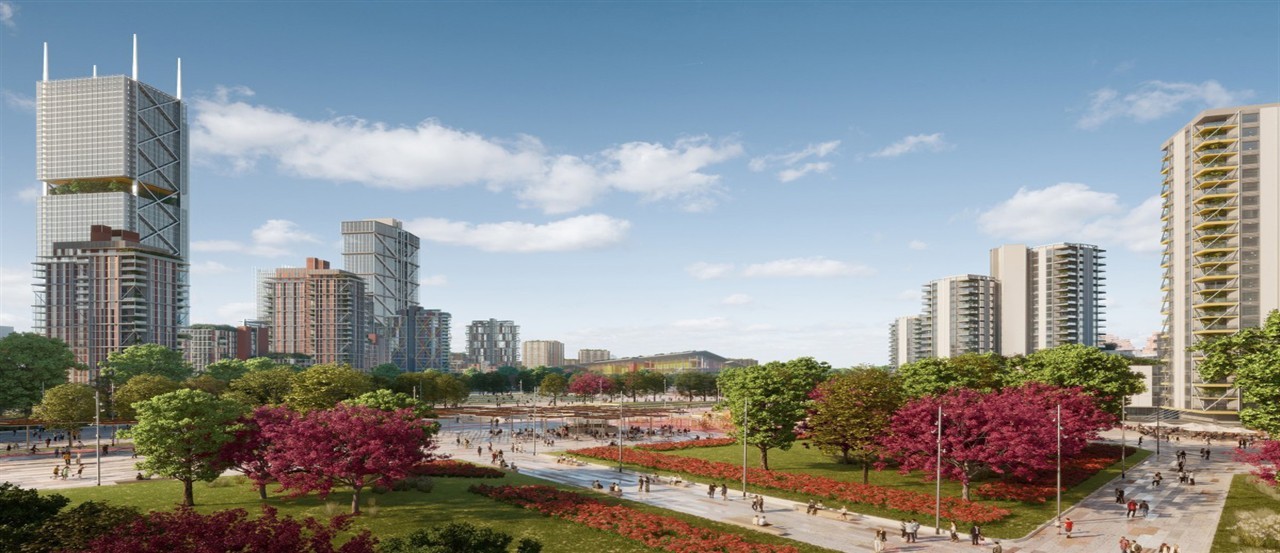
Beyond Madrid Nuevo Norte, to the southeast, a major expansion area spanning close to 19 million square metres is entering a defining phase, with more than 13,000 homes already unlocked in initial stages and total planned investment reaching approximately €8 billion. The scheme is structured around a mixed-use model, with roughly 62% allocated to residential and 38% to economic activity, including logistics, retail and office space, positioning the area as a self-sustained urban ecosystem designed to accommodate tens of thousands of new residents.
This southeastern cluster is reinforced by neighbouring developments covering more than 8 million, 5.7 million and 4.7 million square metres respectively, which together will deliver over 55,000 additional homes over the coming years, around half of which will be affordable housing. These projects are now transitioning from planning into execution, with several thousand units already under construction and further phases—representing multi-billion-euro investment volumes—scheduled to break ground between 2026 and 2027. Alongside residential delivery, these areas will incorporate more than 3 million square metres of green space, as well as significant allocations for industrial, tertiary and public-use facilities.
In parallel, the northeastern corridor is consolidating its role as a hub for next-generation urban expansion, with projects combining close to 290,000 square metres of buildable area and over one million square metres of land, integrating residential, retail and tertiary uses in a low-density, sustainability-led environment. These schemes are expected to begin vertical development from 2026 onwards, with first deliveries targeted towards 2028.
Further north, in the metropolitan fringe, a new large-scale district is being planned across more than 200 hectares, with capacity for approximately 8,600 homes—over 50% of which will be affordable—and an estimated investment of €2.3 billion. The project is being positioned as a “smart district”, incorporating more than 50 sustainability measures, from renewable energy systems to advanced mobility and water management infrastructure, aligning with the increasing institutional focus on ESG-compliant urban development.
Across these axes—north, east and southeast—Madrid is effectively delivering a residential pipeline that exceeds 120,000 homes for the 2025–2030 period, supported by unprecedented levels of infrastructure, public investment and private capital. For investors, the opportunity is not only defined by scale, but by the ability to access different stages of the value chain, from land acquisition and development to forward funding, joint ventures and stabilised income-producing assets in one of Europe’s most supply-constrained residential markets.
Don’t miss this opportunity to engage with industry leaders and get to know the projects shaping the future of Spain’s real estate landscape.
REGISTER HERE

