


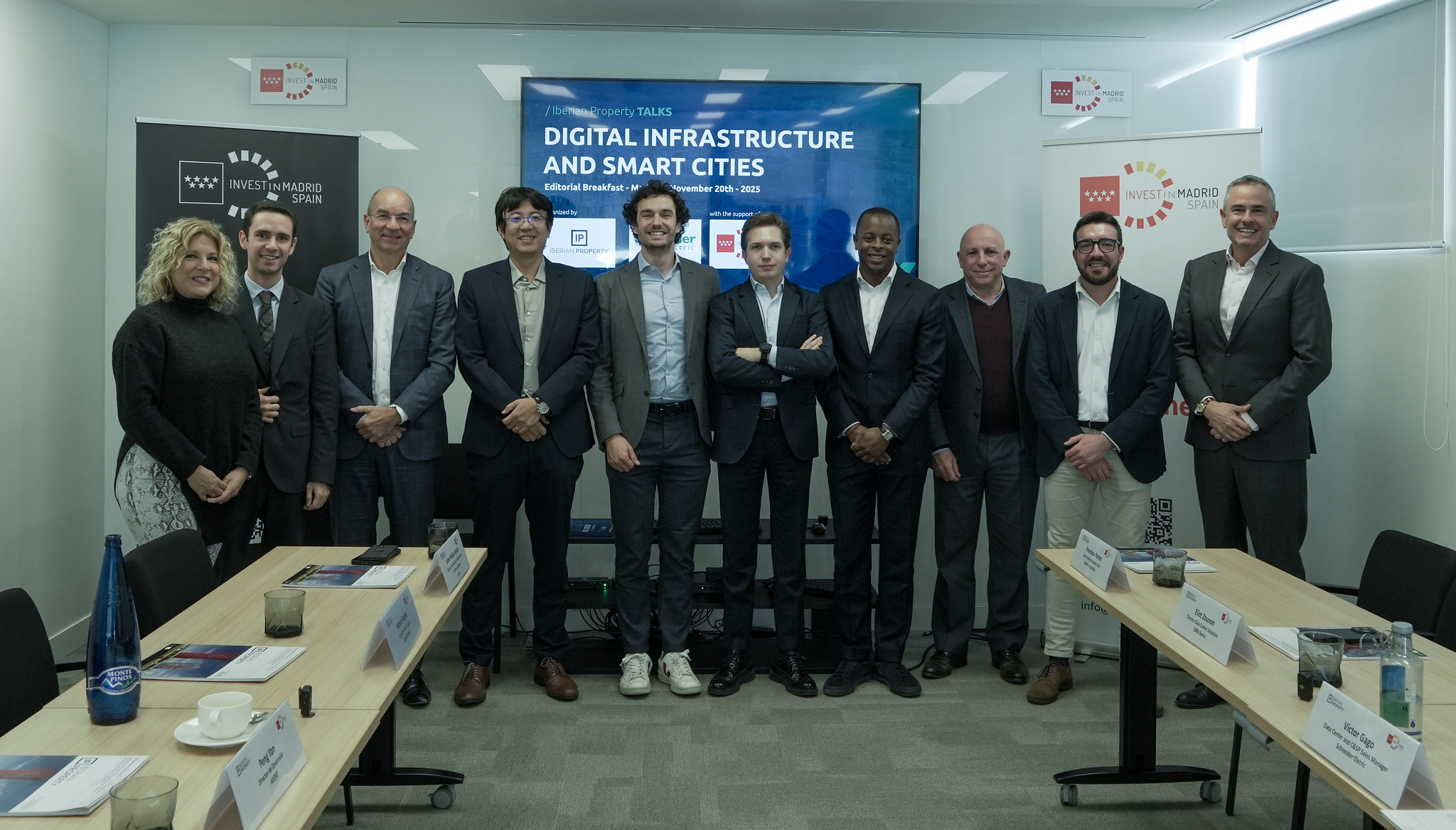
On the 20th of November, Iberian Property convened an Editorial Breakfast under the theme Digital Infrastructure and Smart Cities, hosted at the offices of Invest in Madrid — with the support of Schneider Electric. The session brought together investors, operators, policymakers and infrastructure specialists to explore Madrid’s emergence as a Southern European digital hub, and the opportunities and bottlenecks shaping the next wave of growth.
Having Data Centres at the core of the debate, Francisco Porras, Data Centres Business Unit at Merlin Properties, elaborated on how a commercial real estate investor transition into infrastructure. He argued that “many funds enter the sector to build and sell — which would have been the logical route for us if a ready-made platform had existed. But because it didn’t, we had to develop it ourselves”. Merlin’s portfolio was built asset by asset, so its strategy in data centres is very much build-to-hold oriented, consistent with its structure as a REIT/Socimi focused on rental income.
The key difference for Francisco Porras is horizon. “I look at this market over 20–30 years, not over 5. That time frame is what allows us to take risk. A five-year fund could never have absorbed what happened to us in Getafe, for instance, where power did not arrive when expected”. Yet, on the other side, Merlin Properties leased Barcelona and Álava immediately, which compensated that delay. If it had only backed one site, as a typical fund might, the company would have suffered a major setback.
The socimi entry into data centres followed the sale of the TRI portfolio leased to BBVA. Inflation and interest rates made those assets increasingly expensive for the tenant, so Merlin took the opportunity to exit at a fair value, reduced leverage significantly to around 30%, and still had capital left. “We had a responsibility to redeploy that capital for shareholders and we identified early the opportunity to diversify, at a moment when logistics was becoming crowded”. And importantly, this does not mean Merlin will abandon its core sectors — but we could not enter this with small moves: shareholder pressure means we had to scale from day one, underlined Francisco Porras. It should be recalled that Merlin’s ambition is to have 200 MW placed by 2027.
Another acknowledged challenge was that Madrid does not have infinite power. Ideally, Merlin would have concentrated everything around Madrid, near its team and universities, but available power pushed them south. “Even in an industrial estate, administrative hurdles are significant: we waited 1.5 months just for the line permit, and 11 months for environmental approval in an already developed industrial zone. This illustrates how demanding development is”.
Furthermore, the Data Centres Business Unit originally thought hyperscalers would be the primary tenants. But not long after they announced their own build programmes. “Fortunately, the AI wave arrived with tailwinds and enabled us to specialise in a niche: training of large AI models, which requires enormous power and highly sophisticated fibre connectivity. From Barcelona we serve Europe, and from Álava we serve the US. These are not local workloads — and this is a crucial difference”.
This niche demands huge power density, proximity to subsea cables, extreme scalability and the ability to expand rapidly. For that reason the socimi announced the Extremadura project, initially considered ambitious, but already attracting interest. AI operators do not want fragmented footprints — they want large, continuous blocks of power.
In practice, this is a role that should naturally be supported by institutional planning. Other European countries have prepared large, pre-equipped zones for digital infrastructure. “Here, we must assemble everything ourselves — land, planning, fibre, substation, permits — and that takes three or four years before construction even begins. Internationally this hinders our position as we are performing part of the industrial groundwork that elsewhere would be public”, Francisco Porras recognized.
That is why Merlin is gradually becoming an industrial company — it now hires more engineers than economists or lawyers. Each new data centre is different because technology evolves in 6–8 month cycles. And to play in AI today, you must adapt constantly — technically, operationally and strategically.
Regarding the impact of electricity costs, Francisco Porras justified it depends heavily on the client profile. "We host customers running machines at extremely high intensity — supercomputers. Visiting clients in Miranda I saw racks that cost €3 million each. If those machines are not operating at 80–90% utilisation, their business model collapses". These are AI factories, producing tokens to train models, similar in many ways to Bitcoin mining. To amortise that capex — and they replace machines more or less every six years — they must run flat out.
The sooner they generate revenue, the better. But right now, for this niche, electricity cost is secondary. What matters is power availability. In the long run, for long-term holders, once the market matures, energy cost will matter more for expansion decisions. But today, in this phase, demand will flow to wherever there is available capacity.

Lease contracts: a thin balance between stability and adaptability.
Francisco Porras confessed that he wished Merlin could have a simpler structure, but the truth is that every client requires a bespoke solution inside the data centre. Often those are technically complex requirements, with heavy contractual and legal implications, and service levels that depend not only on the company, but also on third-party infrastructure.
“As a SOCIMI the challenge is even greater, because our model is fundamentally rental income, not ancillary services. We are obliged to convert revenue into euros-per-square-metre, even though our underlying business driver is megawatts”. Unlike a global colocation operator, Merlin cannot monetise cross-connects, network services or other sub-products that would naturally sit around the asset. That forces creativity in contractual structure: through clauses, uplift mechanisms and indexation it translates a complex service into a compliant rental framework. Merlin has succeeded in doing that so far, but it is not straightforward.
Another difficulty is that—unlike mature hubs—Merlin cannot rely on pre-existing ecosystem synergies. “There are efficiency gains that come from developing at scale and within concentrated clusters, unfortunately in Spain we did not have a large, pre-planned campus ecosystem to plug into. So, we have needed to build incrementally, region by region, often in locations where grid availability exists but support infrastructure still has to be assembled project-by-project”. This requires to take on work that is not traditionally the landlord’s role: helping clients secure long-term PPAs (power purchase agreements), coordinating talent pipelines with universities, establishing partnerships to support specialised operations, and anticipating their future expansion needs.
“Ultimately, for us the critical objective is not only attracting tenants, but retaining them and enabling sustained growth. In a global, location-agnostic market, Merlin must ensure that when a client grows by 100MW, 80MW of that growth happens with us”. That, Francisco Porras explained, means customised contracting, energy support, and building the wider ecosystem that will allow Spain—and its assets within it—to scale competitively over time.
This is a fast-moving industry: decisions on location and investment are being made in weeks, not years, and whoever secures strategic positions now will gain the long-term advantage. "We have seen inspiring examples elsewhere — in Norway, for instance, high figures of the Royal family actively engage with global technology companies to understand their needs and facilitate investment".
As the Editorial Breakfast discussion drew to a close, the Madrid’s Digital Strategy Director offered a candid reflection on the challenges ahead. Madrid has proven its capacity to scale – live data-centre capacity has increased almost 90% in recent years – yet the next phase requires clearer strategic signalling: where should the cluster grow, which projects add value, and how can institutions reduce uncertainty for serious, long-term investors?
The private sector side final "wish-list" included a unified national framework to consolidate permitting across administrations, and higher procedural agility compared with markets where silence implies approval – not rejection.
You can read the full report on this Editorial Breakfast: HERE