


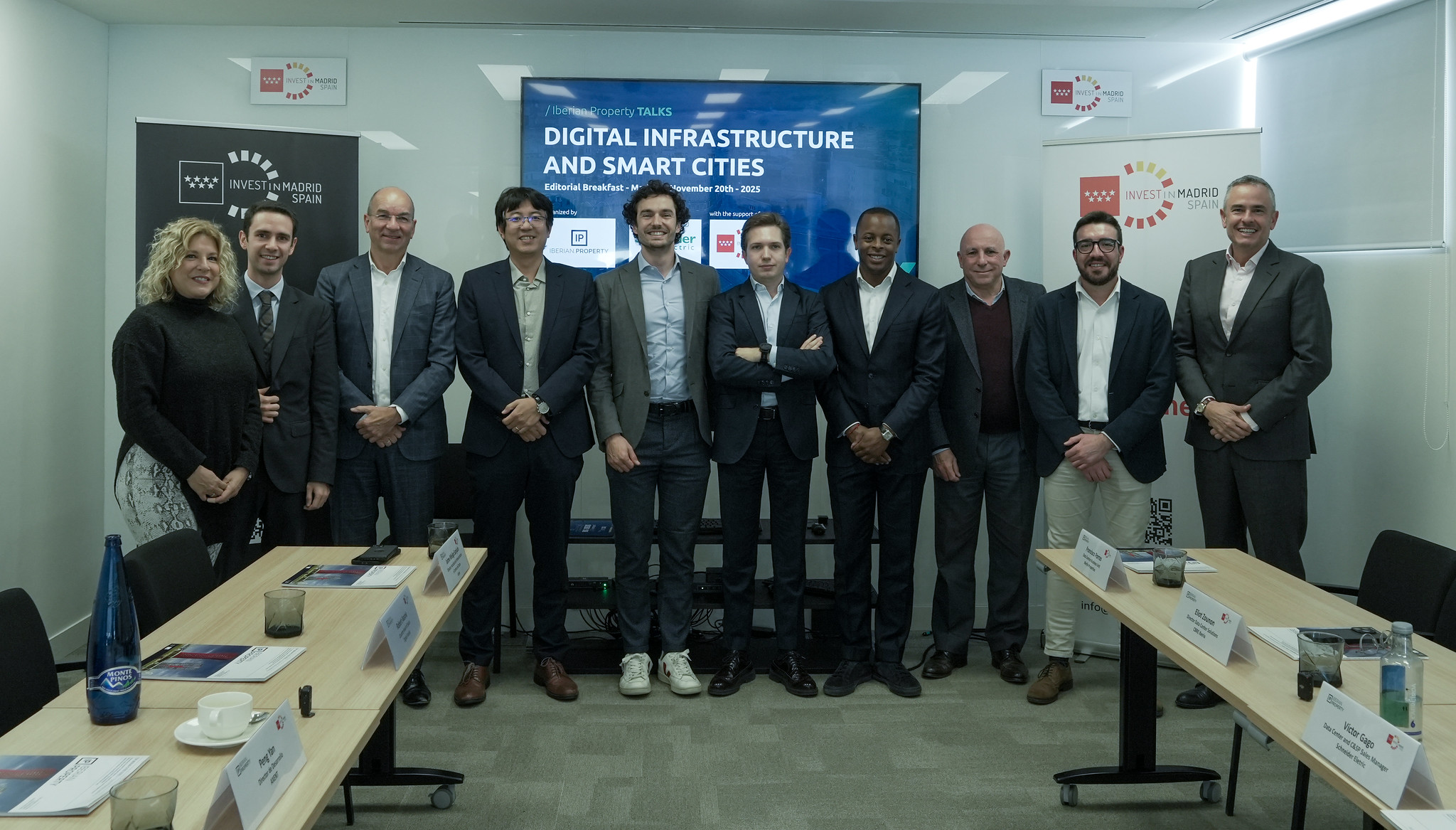
On the 20th of November, Iberian Property convened an Editorial Breakfast under the theme Digital Infrastructure and Smart Cities, hosted at the offices of Invest in Madrid — with the support of Schneider Electric. The session brought together investors, operators, policymakers and infrastructure specialists to explore Madrid’s emergence as a Southern European digital hub, and the opportunities and bottlenecks shaping the next wave of growth.
The scale of innovation is now shaping location strategy in the data centre industry, with recent announcements such as Jeff Bezos’ ambition to build data centres in space, and, at the other extreme, the launch of the world’s first commercial underwater data centre in China - these moves are motivated by scalling sustainability and energy efficiency, two topics which Víctor Gago, Data Center & C&SP Sales Manager atSchneider Electric, reasons having surpassed land availability as a criteria on the investment decision check-list. Time and energy have become the decisive factors. Schneider Electric recognises public-sector efforts to shorten permitting timelines in several regions of Spain, but there is another timeline that is just as critical: construction itself.
“The available megawatt must be maximised for the client, and construction needs to be designed with that in mind. Improving energy efficiency is vital — not simply to reduce cost, but to increase usable power for clients”. This is particularly visible in cooling systems, which are increasingly liquid-based and enclosed, offering much higher efficiency than traditional air cooling.
The pressure is immense: we are moving from considering 160 MW racks as advanced, to Nvidia planning 1 GW racks, which forces continuous innovation to maximise performance. “Modular construction, which was barely considered a few years ago, has now become standard in almost every current project. It offers flexibility to adapt to technological advances — and crucially, helps reduce construction times”, Víctor Gago argued.
On this subject, the Digital Strategy Director at the Comunidad de Madrid, commented: “We now have a clear internal objective: approach a 24-month delivery horizon, and eventually the 18-month market benchmark. If we achieve that, there will be no reason for Madrid to lose projects to other regions — except when power availability makes it unavoidable”.
You can read the full report on this Editorial Breakfast: HERE

