


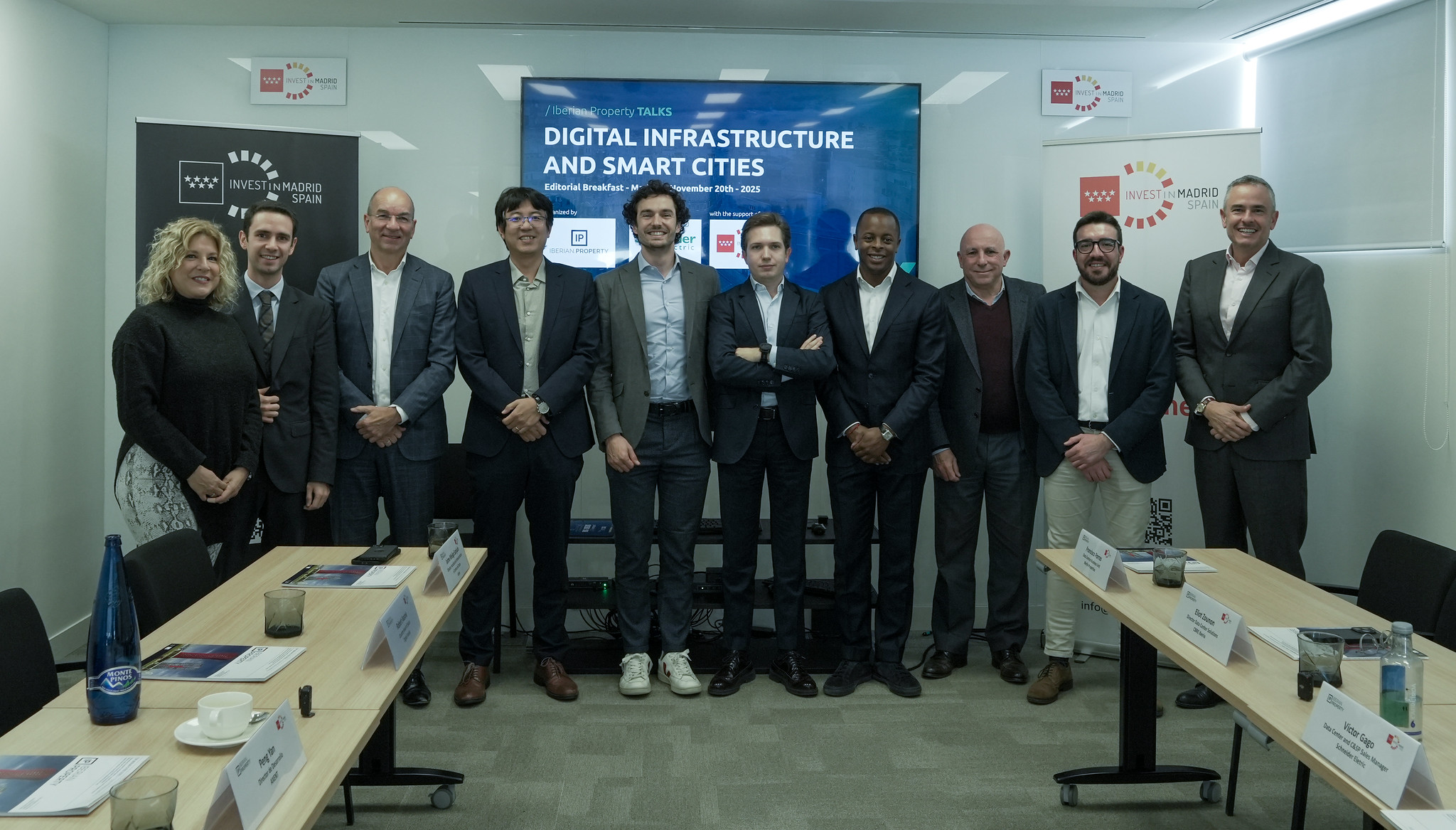
On the 20th of November, Iberian Property convened an Editorial Breakfast under the theme Digital Infrastructure and Smart Cities, hosted at the offices of Invest in Madrid — with the support of Schneider Electric. The session brought together investors, operators, policymakers and infrastructure specialists to explore Madrid’s emergence as a Southern European digital hub, and the opportunities and bottlenecks shaping the next wave of growth.
Having Data Centres at the core of the debate, Robert Assink, Country Head of Spain at Digital Realty, shared the company’s trajectory in Spain, a history of 26 years, which according to him in many ways helped creating the colocation data centre market here. In the beginning, the American REIT focused on enabling network interconnection in a neutral space that supported the liberalisation of the telecommunications market. This was before the internet was widespread; the exchange of traffic was mainly voice, not data. At that time, interconnecting networks was slow and bureaucratic. “A neutral, independent physical meeting point, where operators could connect in minutes rather than months, was revolutionary. That is how the concept of the carrier-neutral data centre emerged”.
As technology evolved, internet traffic exploded. Voice became voice-over-IP, and digital services were created over that connectivity layer. Data is useless if it cannot move. “Storing information is easy — the value is in its ability to travel between points. That need for fast, reliable movement of data became the engine of our growth”.
In Spain, each phase of the market brought a different wave of demand: first, telecom liberalisation; then internet platforms, digital media and gaming; then, during the 2008–2012 crisis, enterprise outsourcing — public and private companies shifting from capex to opex. After that came the cloud-on-ramps era, with Spanish companies needing direct access to cloud platforms hosted abroad. And from 2020 onwards we began to see the large global investment announcements — Amazon building in Aragón, global cloud platforms seeking colocation partners, and now AI workloads, especially GPU-based infrastructure, driving a new kind of scale.
Different demand types have created different data-centre models. Digital Realty emerged as a multi-tenant operator — many clients under one roof. “To give an idea: across our four data centres in Madrid, spread across three locations connected by fibre, we have 17,000 cross-connections between customers. These allow them to buy and sell traffic and services directly with each other. It is like a digital airport hub — the density of connections creates value. This is not a single building with a single client: it is an ecosystem developed over 25 years, and you cannot build that overnight”.
Looking forward, Robert Assink points out AI as the clear main driver. “In 2023, we signed a single contract equivalent to all the capacity we sold in the previous ten years combined — for AI and cloud computing from the same customer. But even then, we deliberately chose not to sell all capacity to one buyer, in order to preserve the value of interconnection for the wider ecosystem”.
Where will demand go next? Studies forecast that by the end of the year around one-third of future power demand for data centres globally will still be non-AI. Much of that is inference, which can be slightly further from the city, but the bulk — especially high-density inference — must remain close to population centres, GDP concentration and the core economy. “In the Iberian Peninsula, that means Madrid and Barcelona. We are also evaluating Lisbon. We receive many proposals to go to remote areas that offer nothing except electrical power — but power alone doesn’t make a data centre ecosystem”, the Digital Realty representative concluded.
Lease contracts: a thin balance between stability and adaptability.
For Digital Realty the model is quite straightforward: everything is highly standardised with full end-to-end processes. "We work with a master Service Level Agreement that defines the technical and service standards, and in around 90% of cases clients sign the standard version", granted Robert Assink. Only very large global clients require adaptations to local CPI indexation, jurisdiction, or global risk policies.
Clients can choose usually between three-, five- or ten-year terms, with automatic renewal options if they want them. But importantly, "we are not selling power density or a specific engineering configuration — we are selling a service level. How we technically deliver that service is secondary for most clients. When it’s Huawei or Microsoft, the conversation is different, but in the vast majority of cases the value proposition is the service, not the engineering design".
Regarding the overall role of the US REIT, Robert Assink emphasised Digital Realty’s desire not to become an energy strategist at all, remarking that the company has effectively been forced into that role: “we just want to build and connect facilities, like a developer plugging into an electrical cabinet when building a house.” Together, their comments reflect a shared frustration: operators are being pushed into solving energy issues that should sit at system level, rather than at asset level.
The private sector side final "wish-list" included a unified national framework to consolidate permitting across administrations, and higher procedural agility compared with markets where silence implies approval – not rejection.
You can read the full report on this Editorial Breakfast: HERE